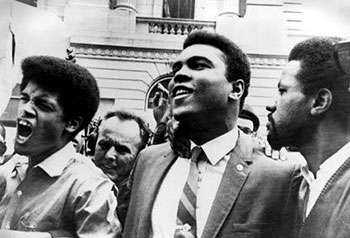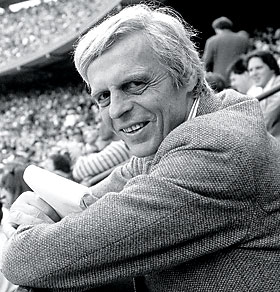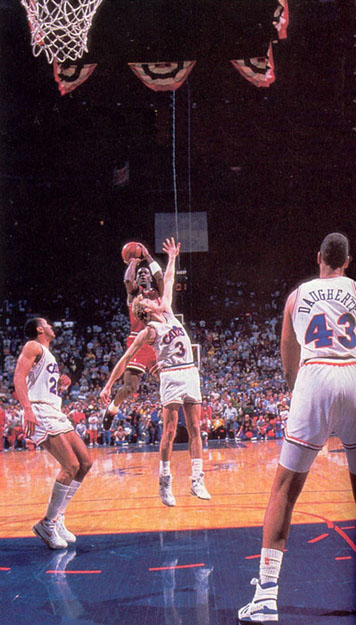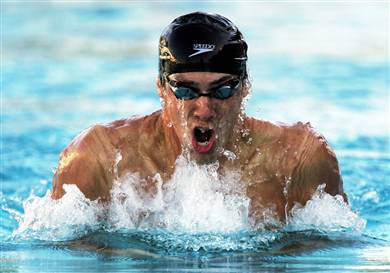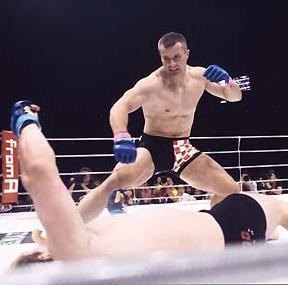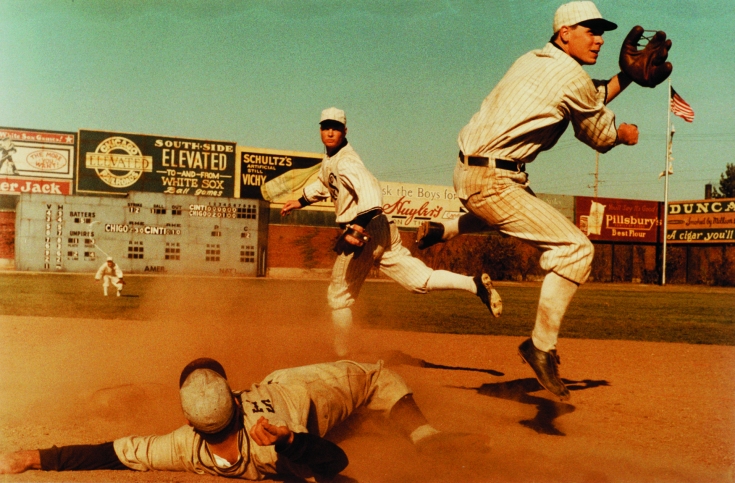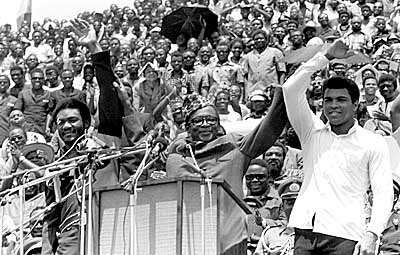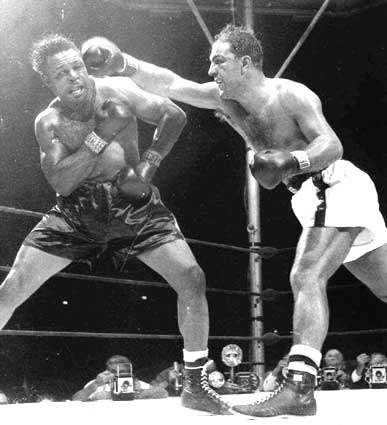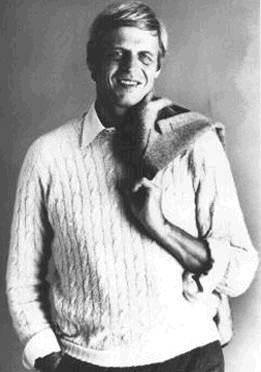
George Plimpton - was he a No Masian? I can't figure that one. He had all the requisite fascinations, including a lifelong preoccupation with the three b's - boxing, baseball, and bullfighting. He sparred with Archie Moore (who bloodied his nose with his first punch) at Stillman's, he took the field as the quarterback of the Detroit Lions, he was an intimate of Ali and is practically the co-star of
When We Were Kings (a friend of mine and I have often said that on first viewing it's hard to tell whether that movie is about Ali v. Foreman or Plimpton v. Mailer.)
In short, his credentials in all No Masian pursuits are impeccable, and yet... he was such an unbearable snob. Sometimes with Plimp you got the idea that all the wonderful things he got to do were just a big joke to him, the trust-fund daredevil showing off his derring-do with the rank-and-file and then reporting his adventures back to the blueblood Scotch-and-soda crowd, who never cared much about his exploits in the first place, who were only interested in Plimpton for the same reason they were interested in anyone - because he was rich.
This impression was bolstered for me by my only meeting with him, at his legendary townhouse on the Upper East Side at one of his legendary parties for his legendary quarterly,
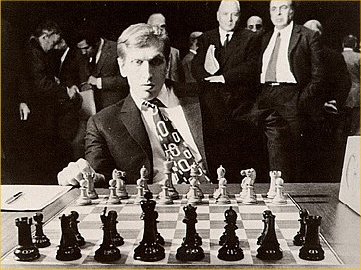
The Paris Review (the party shot above was taken at Plimp's in 1965 - ole George is on the bottom left, and Capote is on the couch in the center talking to William Styron... I was not at this affair). I worked then at Columbia University Press as a poetry editor in the reference department (another time and another life for young Large) and was friends with many aspiring poets from the MFA program who frequented
The Paris Review scene. One of them, who had recently won a big award from the publication and was a favorite of its poetry editor, Richard Howard, brought me along to a big throwdown at Plimp's house. It was in 1998, an affair to celebrate the release of the British edition of the quarterly. I remember that because England had recently suffered its memorable loss on penalty kicks to Argentina in the '98 World Cup, that heroic match in which they played almost the entire second half a man down after Beckham was sent off for kicking Diego Simeone. There was a group of very drunk and disorderly Brits at the party who knew from reliable sources that Becks had immediately flown to New York after the match to rendez-vous with Mrs. Becks. They were intent upon finding him and letting him know their feelings concerning his conduct on the pitch. I have no idea how that turned out.
Plimpton's parties were epic, of course, and always somewhat insane, largely due to the fact that they started right after working hours, nothing was served to drink but red wine and Macallan, and there was no food to speak of but a sad-looking triangle of brie and some stale soda crackers set far into the center of the covered pool table. Nobody ate, everybody drank, and instability ensued. At the party I attended, there were at least two sudden vomiting incidents. Twenty-one-year-old trust-fund poets had difficulty with the Plimpton diet.
Mailer was there, looking uncomfortable, and Alice Quinn was also in attendance. But most of the crowd was young and beautiful and reeked of savage literary ambition. There can be no finer looking set of nubiles at any Vogue party thrown last week than were at Plimpton's house that night, and the master of ceremonies was trailed by an adoring gaggle of these shiny geese everywhere he went. To my eye, this was
the point of the party, and anything else that transpired was incidental.
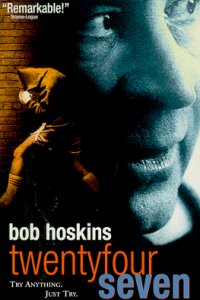
At one stage, my poet friend, who was on close terms with Plimp, led me into George's study, which was officially off-limits to party-goers. There my eyes widened and my heart leaped up. Photographs of the man of the house with Ali, with Alex Karras, with Hemingway, with Swifty Lazar, with Warren Beatty and Diane Keaton, with quite a few members of Hollywood royalty actually (most know of Plimp's participatory forays into the sports world, but he was quite the dilettante bit-part actor as well, with
Good Will Hunting, Nixon, and
Reds among his list of credits). None of these photographs was of the staged, let's-take-a-picture-now variety, but rather shots of Plimp and subject hanging out in restaurants, bars, cafes, training camps, offices, football fields. Oh for such a life, I yearned, moving from frame to frame as if I were in the Louvre.

Plimpton followed us in not long afterwards, wondering what we were up to I'm sure, and then it was just the three of us in the study. He was the magnanimous host, immediately engaging us in conversation, hovering above us, tall and angular and aristocratically drunk. He pointed to a shot of him and Truman Capote and then spoke of the reception of his recent oral biography of Capote, and how despite the fact that it wasn't selling worth a damn (I can still hear him saying this - "it's not selling worth a
damn"), his publisher was so thrilled with it that they wanted him to do another one. They had suggested Elvis Presley as a subject, a subject near and dear to my heart.
"You should do it," I said enthusiastically.
He looked at me with pure disdain and sniffed.
"Not exactly my cup of tea," he drawled, and looked away. Soon after that, he rejoined the party proper.
I stayed late at his house that night and got horrendously drunk, even contemplated stealing a bottle of Scotch I'm ashamed to say (there were seemingly hundreds laying about). I actually outstayed Plimp himself, who took off with one of his gaggles into the raucous night. Unaware of this, I had plopped myself in his study in curmudgeonly fashion and turned on the television to watch the Phillies play the Yankees in what I believe was their first appearance ever at Yankee Stadium. I got locked into this game, and sat there drinking and watching, drinking and watching, blissfully unaware that the party had completely disbanded around me. The game went into extra innings. At one point, I wandered into the kitchen and grabbed a beer, a Labatt's Blue, from the refrigerator. It took some poking around in there to find it. I must have noticed then that I was utterly alone in George Plimpton's house foraging through his fridge for something other than Scotch to drink, but I was too plastered and focused on the baseball game to think that was an odd thing.
The game ended predictably (I'll let you figure that one out) and I left, thank Christ, without nicking anything. The whole evening left a bad taste in my mouth, and I've never been able to feel entirely positive about the man since, which is horribly unfair, I know. He is one of my favorite writers and his approach to sports shaped mine from a very early age. There is absolutely no question that, based on the stats alone, he is a first-ballot No Mas Hall-of-Fame inductee. But I'd be lying to you if I didn't admit that the selection committee has its reservations.
 This week, to get us all primed and ready for the biggest night that boxing has seen in years, our Knockout of the Week series will be the Knockout of the Day, as we will showcase daily a classic Oscar De La Hoya or Floyd Mayweather Jr. stoppage of the past in search of some clues as to what we might see in the ring this Saturday night.