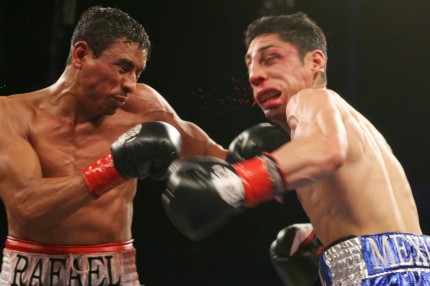
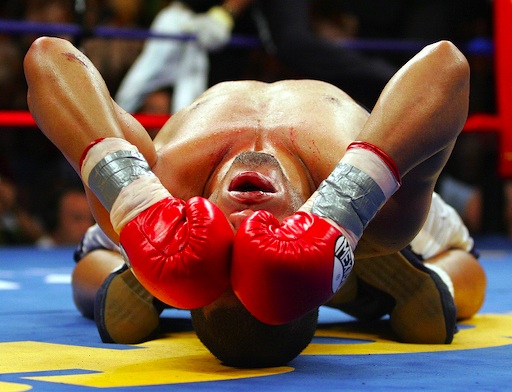
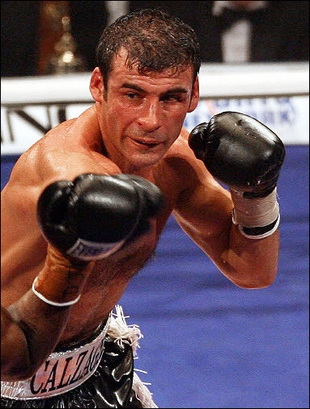
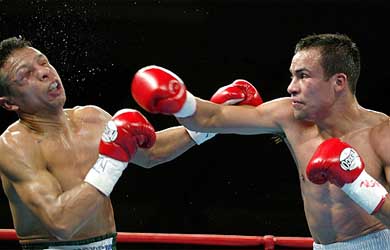
Lot of big name fighters in action this weekend - Antonio Tarver, Vernon Forrest, Chavez Jr., Jorge Arce, even ole Chop Chop Corley, who fights tonight in Miami. None of these fights, however, include top-notch opponents, and so are mostly biding-their-time, cashing-that-check type fights, especially for Chavez, who fights tomorrow night on flippin PPV against Ray Sanchez, a fact that should give you some idea of what kind of pull the name "Chavez" has in the Mexican boxing universe.
So without a big bout to plug, I thought rather than look forward to the Floyd/Hatton fight (we'll be doing plenty of that next week), I would look back to tell the story of a little-known ring classic. The fight I have chosen for our No Mas Knockout of the Week goes all the way back to 1994, when the Hitman Tommy Hearns took on none other than Martin "Raw Dog" Lawrence.
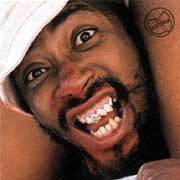
I know what you're thinking - how the goddang hay-ell did Martin end up in the ring with Tommy Hearns? Martin's like a featherweight and in '94, shit, Tommy Hearns was 175 in a speedo.
Well, see, it all went down like this - Martin fought in a charity boxing match where Hearns happened to be a celebrity judge. After stomping his man mercilessly (poor form for a charity event, but hey, that's how the Raw Dog DO), Martin threw an afterparty for himself back at his crib. Hearns showed up, disrespected the Raw Dog, and then proceeded to hit on Mardy-Mar's lady, the stupid fineness highness that is Gina. Still juiced from his big KO, Martin takes offense. After slinging a few choice insults ("They call you the Hitman? Well I just got a call from Sugar Ray... he calls you the GET Hit Man!") he challenges him to a fight, and it's ON.
Of course, in the cold light of the next day, Martin regrets his bravado and fears for his life. But then his soul brother number one Cole informs him that he saw Hearns getting onto an airplane earlier in the morning. Martin realizes, hey, Tommy Hearns ain't gonna hang around in town for no two weeks to fight me! He got better things to do! So Martin plans to train and show up for the fight anyway. That way, when Hearns doesn't show up, he'll look like the bigger man, while the crowd will think that the Hitman punked out.
Surprisingly, at the very last second, Hearns DOES show up. And despite the urging of Gina and the main man Stan ("sometimes it take a big man... to run like a little girl"), the Raw Dog goes through with the fight. What ensues is one of the more bizarre prize-fights in the history of the ring. Hearns wins by knockout in the second, and trust me, you ain't never seen a knockout like this? Marciano/Louis? No. Marciano/Walcott? Uh, not even. Hearns/Cuevas? Dah... Tommy gave Pipino a little love-tap compared to what he does to poor Mardy-Mar. Enjoy.
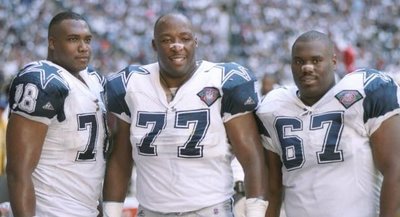
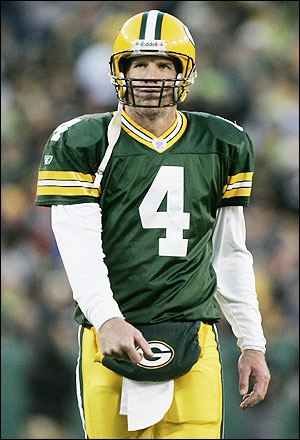
Ah Brett Favre leading his Packers into Texas Stadium for a late-season showdown with the Cowboys in a possible NFC Championship Game preview between the two best teams in the conference.
Obviously, the year is 1996. Monica Lewinsky is still surfing the carpet of the Oval Office and the world is blissfully none-the-wiser. There are few cell phones and no IPods. Lance Armstrong is riddled with cancer and his prognosis looks bleak. Bob Dole is triumphant in defeat. Where have you gone, Admiral Stockdale?
The Pack and the 'Boys have played each other only twice in the last ten years, which is strange, because during the 90's, when each team had a run as the premier franchise of the NFC, they played almost every year during the regular season, and three years in a row, from '93-'95, in the playoffs.
Of course, that is an era of the Green Bay/Dallas rivalry that Cheeseheads would like to obliterate from their cerebral cheddar cortexes. In the ten games played between the two teams in the 90's, the Cowboys won nine of the them. From 1993-97, they played seven of those games, and Dallas won them all.
The signature game of that stretch, and indeed of the Packers/Cowboys rivalry in the 90's, was the 1995 NFC Championship game, played in January of '96, and won by Dallas en route to their win over the Steelers in Super Bowl XXX. Favre, who later won his first of three straight MVP awards, was stellar in the game, throwing for two scores, but he was outdone by the Big Three, Aikman (2 TD passes), Irvin (2 TD's) and Emmit (2 TD's). In the fourth quarter, Larry Brown gave everyone a Super Bowl preview, intercepting Favre to set up the Cowboys' last scoring drive.
The next season, '96, the Pack won the Super Bowl, but they still couldn't get the Dallas monkey off their back, losing to the 'Boys 21-7 in a marquee, week 12, Monday Night Championship game rematch that was the regular season game of the year (seven Chris Boniol field goals for Dallas in that one, tying the NFL record). Indeed, one could argue that the only reason the Pack won their Super Bowl that year was because Carolina beat Dallas in the Divisional Playoff. Barry Switzer and the Big Three had Green Bay's number at that point for sure, and had they gotten past the Panthers, they would have headed into Lambeau with a world of confidence.
Green Bay finally exorcised the Dallas demon in '97, throttling the Cowboys 45-17 on a 4-TD afternoon from Favre. The game ended what was at that point an eight-game losing streak to the silver and white, and transported Cheeseheads everywhere back to those glorious Ice Bowl days of yore, when Lombardi's warriors used to push around Landry's laundrymen like the upstart sissies that they were.
Steve, I was really into those Sampras/Fed matches, and just the concept of two dudes who have a... well not just a claim, but pretty much a complete ownership right now of the Best Player Ever debate going head to head. Other than the Sampras/Fed Wimbledon match, are there any other matches historically where two guys with such a claim played each other competitively? -Large
The Roger and Pete show has been better, more competitive, and more buzz-generating than any fan had a right to think it would be. But that may have been part of the plan, as they have another match scheduled for Madison Square Garden next March. A win by Sampras this weekend just made that one a lot more enticing, wouldn’t you say?
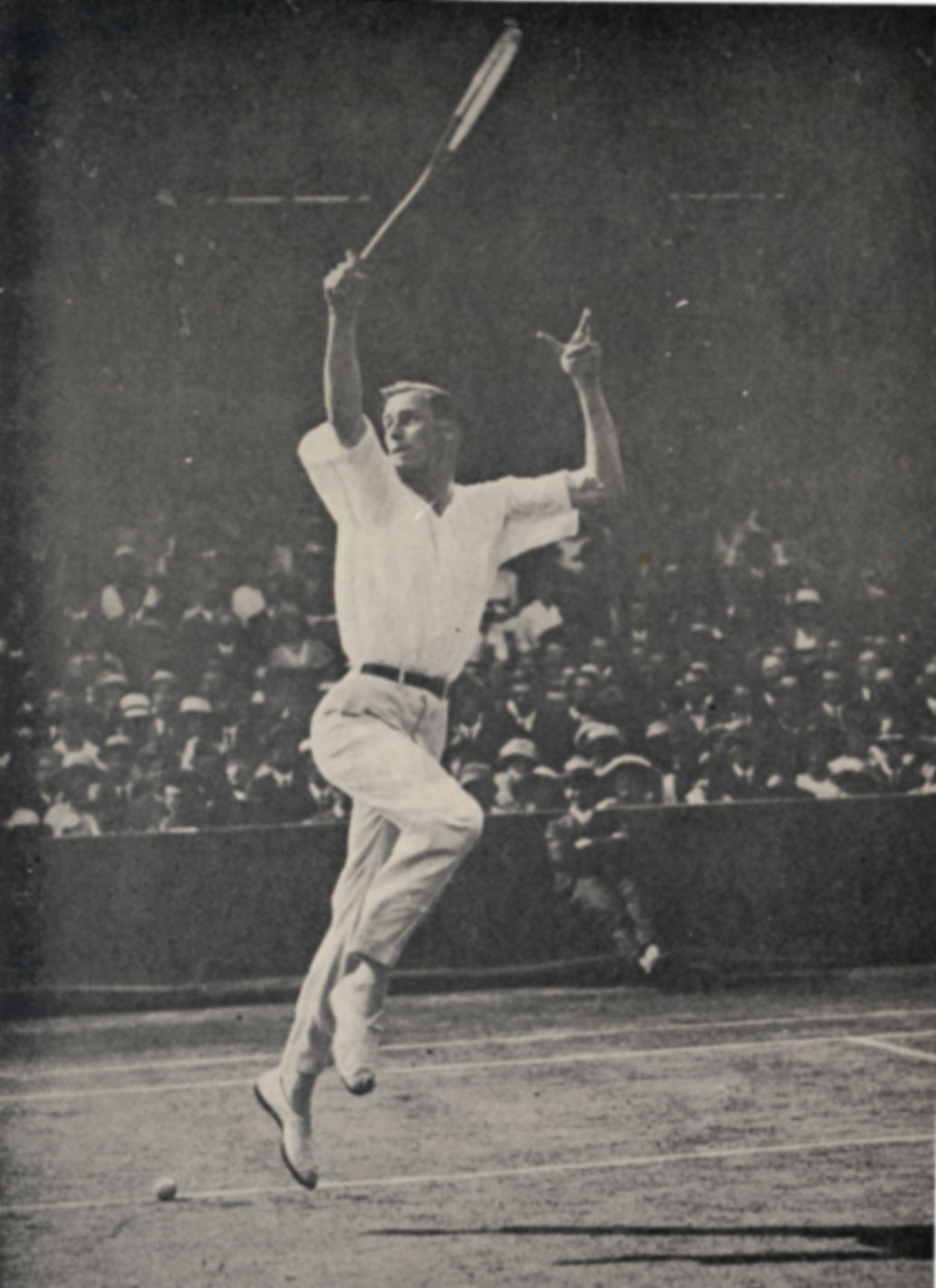
Men’s tennis has a long history of aging legends going down valiantly to the big dogs of the day. In the Pre-Obscene-Money era, the best guys hung around as long as they could and often overlapped with the next generation. You can trace a line of descent from Bill Tilden, who dominated in the 1920s, to Federer in just five matches.
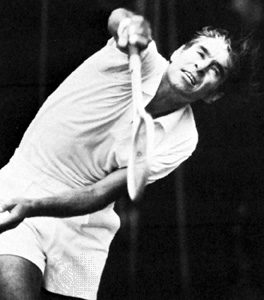
1941: Tilden, 48 and 10 years past his prime, plays 25-year-old Don Budge, who had won the Grand Slam two years earlier, in a 58-match tour. Tilden loses 51, but wins seven. 1957: Budge, 41, beats the No. 1 pro in the world, Pancho Gonzalez, 29, in straights in L.A. 1971: Gonzalez, 43, beats 19-year-old Jimmy Connors in three sets, also in L.A. 1989: Connors, 36, beats Sergi Bruguera, a future French Open champion, in Germany 2000: Bruguera, 29, rolls an 18-year-old Federer 6-1, 6-1
Tilden: five times as good as Federer!
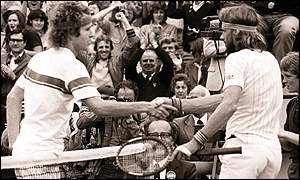
As far as all-time greats going at each other face to face, that tends to happen as one is on the way up and the other on the way down. By definition, there’s room for only one alpha dog at a time—if Fed and Sampras had played over the same years, neither would own as many Slams as he does today. Perhaps that explains why the Borg-McEnroe Wimbledon matches are so well remembered. At the time, Borg was beginning to be called the greatest player in history; three years later, many polls had McEnroe as the Goat (greatest of all time). Their rivalry is the only time I can think of where two guys at that very, very, very top level went head to head in their primes.
Here’s a list of a few of the other legend vs. legend face-offs from the relatively recent past:
Rod Laver d. Pancho Gonzalez, 4-6, 6-3, 7-5, 6-4, U.S. Pro Championships, 1964 Until the Open era, a top player would typically ascend to a position of dominance in the amateur ranks and then, to make a buck, he’d disappear into a pro tour that consisted of one-nighters held in gymnasiums across the world. It’s too bad these events weren’t better covered, because they featured big tournaments and hundreds of matches between all-time greats—one decade’s best player would have to dethrone the previous decade’s. The biggest annual event was the U.S. Pros, at Longwood, outside Boston. By ’64, Gonzalez, the reigning champion of the 1950s, had won eight U.S. Pros. He went for his ninth in a massive storm against Laver, who had won his first (amateur) Grand Slam two years earlier. They played through the rain and wind—men were men, etc.—and by the time it was over the world had a new best player. Laver would go on to win the event five times.
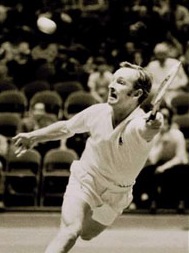
Laver vs. Bjorn Borg I had no idea until I looked it up yesterday that these two had even played a real match. But by the ATP’s calculations, they faced each other seven times from 1974 to ’78 , as Laver was aging and Borg was rising. Borg got the better of him in five of those matches, including the last four. The first time they played, on carpet in Barcelona in ’74, the baseliner Borg sent the net-charger Laver home 6-1, 6-1. (I wonder how many times in his career the Rocket lost by those scores?) Their best match came in Dallas the following year, also on carpet. It was a long five-setter won by Borg.
I’ve seen a tape of a semi-exhibition tournament they played in Hilton Head in 1977—watch two minutes of it below (with Pancho commentating; talk about a Goat-fest). I remember Borg, so it was the 30-something Laver who was the revelation for me. I haven’t seen many clips of him, and I was awed by the consistency of his shot-making—he could do anything with the ball—and his high-energy, all-court attack. (Check out that low forehand volley from no-man's land.) You could see that John McEnroe learned a lot from watching his fellow lefty as a kid. On this day, neither Borg nor Laver seemed to have a distinct advantage over the other. Like Federer and Sampras, they were from slightly different eras, but they belonged on the same court.
Borg vs. John McEnroe As I said, we remember this rivalry well because it was that rare moment in sports when two of the best ever are at their peaks at the same time. No wonder Borg quit when McEnroe took his spot at No. 1—he may have realized that there was only room for one Goat at a time, and he couldn’t conceive of himself as anything else.
As far as how their games matched up, I think my fellow TENNIS editor Pete Bodo had the best take on it: Borg made himself virtually unbeatable because he was willing to play longer points and hit one more ball into the court than his opponent; McEnroe came along and negated that advantage by ending points as quickly as possible. Borg couldn’t counter it, and their 1981 U.S. Open final, which McEnroe won in four sets, sent the Swede into retirement at age 26 and spelled the end of the last golden era of men’s tennis. It would take McEnroe a couple of years to adjust to not having another Goat to play. He could never respect Ivan Lendl the way he did Borg.
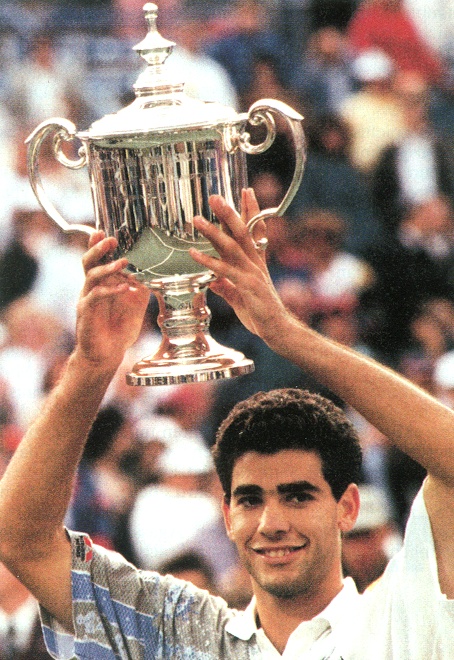
Pete Sampras vs. Ivan Lendl and McEnroe, 1990 U.S. Open The next era-shattering event occurred at the Open nine years later. I’ve written here before about Sampras’ mind-boggling quarterfinal win at 19 over Lendl, who had reached the previous eight Open finals. But Sampras followed it up by ending McEnroe’s last real chance at a Slam in four sets. McEnroe had been usurped by Lendl five years earlier, but the two played what could be called the same game—they were flipsides of the same 70s-80s coin. In this match, Mac was playing against a new type of player. Sampras brought the Big Heat, and all of McEnroe’s chips, spins, and angles couldn’t hold it back. He was done for good. Power tennis had just gotten a little more powerful.
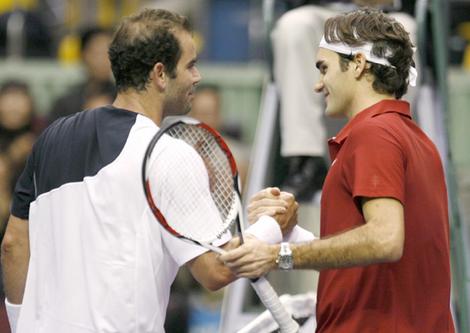
Sampras vs. Federer, 2001 Wimbledon Funny how these things go in decades, isn’t it? Eleven years after Sampras announced the future at the Open, he faced it himself at Wimbledon. This was the only time the two current Goats played each other for real. Federer won a long, winding, intermittently brilliant five-setter. He broke down afterward, and Sampras gave him what I’ve always thought was the most dignified handshake in the history of the sport—class of the titans, I guess you could call it. Here are some highlights from the match and the Sampras post-match interview:
Playing-wise, what sticks out now is how often Federer came to the net. The grass was a little quicker then, and it was still the consensus wisdom that you had to serve and volley to win at Wimbledon (Lleyton Hewitt would put that idea to rest the following year.) Plus, against Sampras you had little choice. Unlike today’s players, he could take the net from you if you didn’t take it from him first. The differences in their games are clear during this match: Sampras hit a heavier, more penetrating ball; Federer was smoother and more consistent all around. The new all-baseline era was about to begin.
Sampras vs. Federer, 2007 That brings us to last weekend’s exhibitions. There’s only so much you can take away from an exo. Not only are the players not giving their absolute best, they’re not even really allowed to; a lopsided win is the ultimate faux pas in these things. Still, I was struck by one thing: Sampras’ serve. I’d forgotten that it was the most effective single stroke in the history of tennis. Smooth, efficient, technically dead on, it was still good enough five years later to keep Sampras in these matches by itself. I know Federer wasn’t going out of his way to break Sampras, but I was surprised he didn't get a better read on his serve. I’m used to seeing Federer handle even the most lethal deliveries with nonchalance.
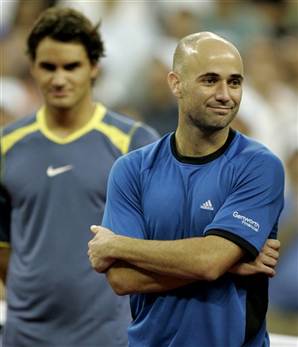
Over the past year, I’d gradually begun to believe that Federer in his prime was a better player than Sampras in his—Fed just has more ways to beat you. I’m not going to change back because of three exhibitions on fast courts, but seeing that Sampras serve again was enough to make me say, “Hmmm, not so fast…” It’s classic hedgehog-fox: Federer knows lots of ways to win, but Sampras knows one big way. Honorable Mention: Andre Agassi vs. Jimmy Connors, 1988 and ‘89 U.S. Opens; Andre Agassi vs. Roger Federer, 2004 and 2005 Opens As an 18- an 19-year-old, Agassi beat an aging, angry Connors twice at the Open, the second time in five sets. As a 34- and 35-year-old, he lost two close matches to Federer, the first time in five sets. The standard line in tennis is that you can’t compare eras, that there’s no way that 5-foot-8 Rod Laver with his little wooden racquet could have stood on the same court with the 6-foot-2, midsize-wielding Federer. I’ve always agreed, but Agassi’s career—and, to a lesser extent, the Borg-Laver and Fed-Sampras exhibitions—makes me wonder whether that concept is as self-evident as we think. Agassi, who was never a candidate for greatest-ever, was there to finish the former No. 1 Connors off when he was a kid, and he was still there to challenge the next era's No. 1 two decades later. (In fact, he gave Fed his biggest challenges at the Open each of those years.) Who knows - maybe tennis’ eras aren’t as different as we think, and the very best would have found a way to compete on their own terms in any of them. Maybe all we can say about Laver, McEnroe, Sampras, Borg, and Federer is: Once a Goat, always a Goat. ---------------------------------------------------------------------------------------- Steve Tignor is the executive editor of Tennis magazine - for more of his writing, check out his weekly column, The Wrap, on the Tennis website.
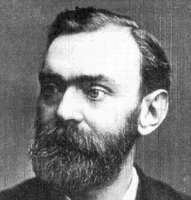
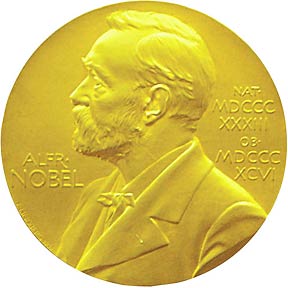
On this day in 1895, an enormously wealthy Swedish Renaissance man who, among his many accomplishments, invented dynamite, signed his last will and testament at the Swedish-Norwegian club in Paris, thereby dedicating a large portion of his fortune to creating what would become over the course of the next century the most famous and prestigious prizes in the world. Alfred Nobel died of a stroke just over a year after signing the crucial document - the first Nobel Prizes were awarded five years after that, in 1901.
A much lamented oversight on Nobel's part here at No Mas, there was no provision made in his will to provide for a Prize in the Field of Athletic Achievement. Nevertheless, among the various winners in the other categories - Physics, Chemistry, Medicine, Literature and Peace - there have been many a notable sportsman and important sporting connections. I will list just a few of these below, with the initial assertion that no, Johnny Unitas did NOT win a Nobel Prize in Anything despite what you or I might have been taught, and a further caveat that I am far more familiar with the Peace and Literature wings of this particular Hall of Fame than those other complicated scientific endeavors:
1906 - Theodore Roosevelt - Peace
It's ironic that Mr. Big Stick himself won the Nobel Peace Prize, but indeed he did, for brokering the Treaty of Portsmouth that ended the Russo-Japanese War. Of course, most of the rest of Teddy's life was dedicated to unbridled combat and killing. He was an avid big-game hunter and pursued the fistic arts throughout his life as a form of spirited recreation. Overcoming a sickly childhood, Roosevelt became a prize-winning pugilist as a youth, and was the runner-up in the Harvard boxing championship of 1880.
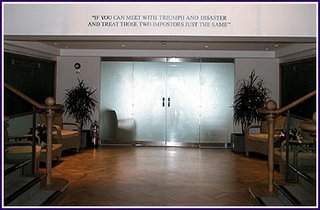
1907 - Rudyard Kipling - Literature Despite pretty much inventing in poetry and prose the stiff-upper-lip code of manhood that has loomed as the lofty ideal for all of John Bull's affairs, sporting and otherwise, ever since, Kipling's most important athletic contribution are undoubtedly the words of his rah-rah poem, "If", that today are writ large above the entrance at Wimbledon through which the players pass onto Centre Court:
If you can meet with triumph and disaster And treat those two impostors just the same
1922 - Niels Bohr - Physics One of the giants of 20th century physics who would later become famous as a mastermind of the Manhattan Project, Bohr won the Nobel in 1922 for his model of the atomic structure. Bohr's lesser-known brother, Harald, with whom Niels was very close throughout their entire lives, was a Danish football star, and played on Denmark's Olympic squad at the 1908 Olympics in London, where he won a silver medal.
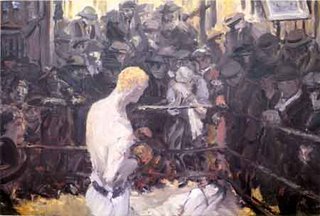
1923 - W.B. Yeats - Literature The ur-Irish poet was a known fan of the sweet science, as was his brother, the artist Jack Butler Yeats, who painted a beloved No Masian masterpiece, The Small Ring (pictured right) in 1930.
1925 - George Bernard Shaw - Literature Also a sweet scientist of note, the famous Irish playwright wrote a hilarious novel about a fighter trying to woo an aristocrat called Cashel Byron's Profession. Later on in his life, Shaw became a mentor of sorts to the boxer-scholar of note, Gene Tunney - the two were lifelong friends and correspondents.
1929 - Frederick Hopkins - Medicine Sir Frederick made quite a major contribution to the future of nutrition - he discovered vitamins. He also discovered that repetitive muscle contraction leads to the production of lactic acid, the prevention of which has been a focal point of endurance athletes ever since. But it is for his work on vitamins that Hopkins won the Nobel, and also for which I mention him here, because without vitamins and the subsequent universe of dubious nutritional supplements, where on earth would today's sports figures turn for an alibi when they are caught using steroids?
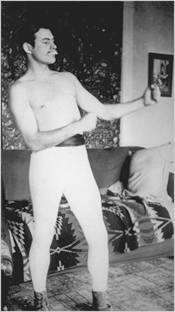
1952 - Ernest Hemingway - Literature I imagine, if you have even a passing familiarity with No Mas, you are aware of our position on Papa. He basically established the blueprint for our entire project, one that begins with, as I have written before, a requisite fascination with the three b's - baseball, boxing and bullfighting (the photograph on the left is Hemingway as a young ex-pat in Paris, where he often rented himself out as a sparring partner to make ends meet). More than maybe any other literary figure in history (Lord Byron? Virgil?), Hemingway illustrated that the sporting life and the life of the mind are in no way mutually exclusive. For that alone, he is our patron saint. One final note - it was the publication of The Old Man and the Sea that finally tipped the Nobel scale in Papa's favor, that novel in which he mythologized Joe D, "the great DiMaggio," long before the leggy Mrs. Robinson was even a twinkle in Paul Simon's eye.
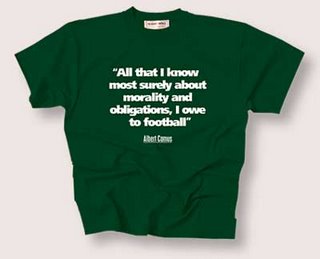
1957 - Albert Camus - Literature As a young man in Algeria, Camus was a great footballer, a goaltender. His days on the pitch, however, were scotched by a bout of TB that he contracted in 1930. I include Camus because of an exchange I once had with an elderly editor at Columbia University Press when I was working there. While discussing Camus, this chap made a remark along the lines of "well, I guess we have tuberculosis to thank for giving us one of the greatest authors of the century." I vividly remember thinking, "yeah, but we also have it to thank for taking away a great footballer, so what's the bloody bleedin difference?" On this score, when once asked which he more preferred, football or the theater, Camus replied, "Football, without hesitation", a quote that I must say I prefer to his far more popular jersey slogan - "All that I know most surely about morality and obligations, I owe to football."
1962 - Max Perutz - Chemistry Perutz is best known for supervising James Watson and Francis Crick in their breakthrough experiments that ultimately determined the structure of DNA. But Perutz himself won the Nobel due to his explanation of the molecular structure of hemoglobin, which is the oxygen-transporting protein in red blood cells. Without this work, there would today be no blood doping, no EPO, and consequently no one would have won the Tour de France in the last 30 years. 1969 - Samuel Beckett - Literature Waiting for Godot and a slew of hilarious though largely incomprehensible novels are not the only claims to fame for this iconic Irish author. He is also the only Nobel laureate in history to have his own entry in the Wisden Cricketers' Almanack (for you unknowing No Masians, this is to cricket what the Ring Encyclopedia once was to boxing). Beckett was both an accomplished batsman and bowler at Dublin University.
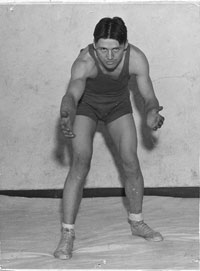
1970 - Norman Borlaug - Peace An agricultural scientist and humanitarian giant, Borlaug won the Peace Prize in 1970 for his tireless work to decrease world famine. Among his many honors are the Presidential Medal of Freedom, the Congressional Gold Medal and enshrinement in the National Wrestling Hall of Fame in Stillwater, Oklahoma. While a student at the University of Minnesota, Borlaug (pictured on the right in his grappling days) was a championship wrestler, and reached the Big Ten semifinals in 1937. While still in college, Borlaug organized the high school program in Minnesota and served as a referee in the first regional and state tournaments.
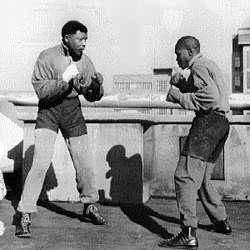
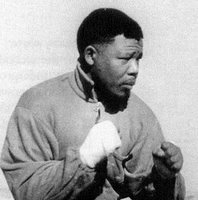
1993 - Nelson Mandela - Peace Mandela was a boxer as a young man, and later would write eloquently of his love of the sport in his autobiography: "I was never an outstanding boxer. I was in the heavyweight division, and I had neither enough power to compensate for my lack of speed nor enough speed to make up for my lack of power. I did not enjoy the violence of boxing so much as the science of it. I was intrigued by how one moved one's body to protect oneself, how one used a strategy both to attack and retreat, how one paced oneself over a match. Boxing is egalitarian. In the ring, rank, age, color, and wealth are irrelevant. When you are circling your opponent, probing his strengths and weaknesses, you are not thinking about his color or social status."
2005 - Harold Pinter - Literature This English playwright is famously obsessed with the sport of cricket, a lifetime fan of the Yorkshire Cricket Club and chairman of the Gaieties Cricket Club (whatever the bloody hell that is). There are frequent references to the sport in his work, and in his house, he evidently has a life-size portrait of himself as a younger man swinging a cricket bat. Also, Pinter wrote a well-known poem about the post-war legend Len Hutton, (pictured right) a poem that in only two lines seems to say about all there is to say about growing old and nostalgic as a sports fan:
I saw Len Hutton in his prime Another time, another time...
(I think that I have mentioned in these annals before that my all-time favorite baseball cards were the 1977 Topps cards. I was seven years old, which played a big part in that. But I still think they were great cards, and there were a few in particular that stand out in my mind - Dave Parker, Jay Johnstone (for some strange reason), and maybe my favorite of them all, the Fred Lynn All-Star card. I really loved the way they denoted the All-Stars that year with the bar across the bottom - red for the A.L. and teal-ish blue for the N.L. Anyhoo... here's the November 27th post from last year, heaping some love on ole Freddie Lynn.)
Sheesh, Fred Lynn. Man didn't even warrant his OWN baseball card in 1975, and yet he went on to be the Rookie of the Year AND the A.L. MVP. What exactly did Terry Whitfield do? And Eddie Armbrister? Other than serving as an excellent George Foster decoy, Ed Armbrister was useless.
On this day in 1975, Lynn was named the MVP of the American League, making him, to that point, the only rookie ever to win the award. In my book, he's still the only man to do it - Ichiro ostensibly did it in 2001, but he was a 27-year-old seasoned professional at the time.
Just as an aside, Lynn has a few other "only''s on his resume as well - he's the only man to win the ALCS MVP as a member of the losing team (with the Angels in 1982) and the only man ever to hit a grand slam in the All-Star Game (1983). He's also the only man, with his fellow outfield-mate and borderline Hall-of-Famer Jim Rice, to ever make me even think about rooting for the Red Sox. Lame though it is, I think I deserve a pass on that, because I was young and impressionable, and his 1977 All-Star card was stupid freaky dope.
The latest issue of The New York Review of Books (yes, yes, we here at No Mas read the NYRB... we have do have lives you know) reveals two rather disturbing facts from the world of sports in its opening two articles.
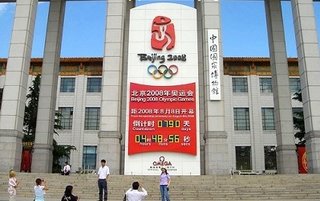
The first fact is the first of what promises to be many disturbing pieces of news regarding the 2008 Summer Olympics in Beijing. In Dai Qing's article "Thirsty Dragon at the Olympics" she reveals a China trapped in a fresh-water crisis that is the result of over-population and short-sighted agricultural planning during the Great Leap Forward of the 1950's, when a relentless project of nationwide river-damming led to, as she calls it, an "ongoing ecological disaster."
Today the farmers outside of Beijing barely subsist on small water allocations and state welfare. Meanwhile, she writes, the Olympic powers-that-be
"... are celebrating the construction of the ultimate 'water follies' which will be ready in time for the Olympic year. These include the vast lake that will surround the titanium, egg-shaped National Grand Theater next to the Great Hall of the People, just off Tiananmen Square, as well as the largest fountain in the world at the Shunyi 'Water Heaven.' The Shunyi water park has been built on the dried-out remains of the Chaobai River - no irony intended..."
Water Heaven? The Water Follies? Merely in these bizarre names for their attractions, it seems that the Chinese authorities are revealing the extent of their perfidy by fetishizing the false abundance of a resource the Western World all too greedily takes for granted. Evidently, for the duration of the Games special pipes will bring potable water to the taps of Beijing for the first time ever. This is a luxury that will cease immediately after the Closing Ceremony. The entire production truly will be a mirage.
Right then... wrapping up this cheerful bit of reading, stomach slightly nauseous, palms on the clammy side, one turns the page and comes upon an article by Frederick Crews called "Talking Back to Prozac." This piece is about the insidious ways in which drug companies are going about creating a need for their drugs by fostering a sense in the media that certain natural personality traits - "shyness" for instance - are actually treatable "conditions." To illustrate this thesis, Crews begins with an example from a 2002 Oprah Winfrey show (oh dear Oprah... the cause of, and solution to, all of life's problems) when the big O's guest was none other than the King of Weed himself, Ricky Williams. Crews writes:
Williams was there to confess that he suffered from painful and chronic shyness. Oprah and her audience were, of course, sympathetic. If Williams, who had been anything but shy on the football field, was in private a wilting violet, how many anonymous citizens would say the same if they could only overcome their inhibition long enough to do so?
Well, we learn, surprisingly enough Williams was paid for his appearance on Oprah by Glaxo-SmithKline, makers of the anti-depressant Paxil. He was not paid to shill for Paxil on the program, however, and he never once mentioned the drug. No, at the time he was only paid to go on the show and tell his story as a sufferer of chronic shyness. Only later did he appear in a Paxil press release, with a caption beneath his photograph reading, "As someone who has suffered from social anxiety disorder, I am so happy that new treatment options, like Paxil CR, are available today to help people with this condition.
Ah, the New York Review of Books. There's just nothing like it really to make the true sports fan, and anyone for that matter, want to go jump off the Bay Bridge.
"Eagles over New England. Revenge is mine saith The Large." - Large
I really believed. I thought we had Miami/Bears on our hands, and that the unlikely Marino stand-in was a ballsy backup by the name of A.J. (Soprano) Feeley. Right down to that godforsaken interception in the end zone, the sight of which entered my ribcage like a cold steel blade, I believed that the Iggles were going to rise like a phoenix from the ashes of their sullen mediocrity and enter the annals of permanent highlight posterity with a single heroic effort. How often do you see references back to that Miami/Bears Monday Night game in '85? Marino to Moore! Marino to Duper! Marino to Clayton! How can this be happening? Every season, as soon as someone goes 3-0, they trot that thing out for a nice little V/O package in the pre-game. Now, I thought, we've joined the club, and no matter what happens, we ruined these smug bastards' shot at immortality and they'll remember this game for the rest of their perfect, Super Bowl ring-laden, supermodel-banging lives.
No Masians, I harbor hate in my heart. I am not the cheeriest of lads in the first place, but last night, I felt murderous. I felt like if I suddenly found myself in the presence of Herr Brady or that twinkle-toed dwarf Wes Welker, if either of them happened to stop by my place after the game for a little late-night hang, well, shit would very quickly turn all Saw II. I would smile in their faces and ply them with liquor and carbohydrate-rich snacks and then make for the kitchen knives and then when they started to pass out from all the heavy pastries and the mickey I'd slipped them in their whiskey I'd stab the shit out of them right there on the rug and then make a martini with their readily flowing blood and drink it in front of them while their pleas for human mercy filled the air and sounded to me like sweet music, like a gentle wind, like the laughter of innocent children playing tag in the sunshine by a burbling meadow brook.
I've often said here on No Mas that one way that you know an athlete is truly great is when you've rooted against him and hated him so damn much you could hardly stand it. Roger Staubach and Tony Dorsett, Steve Garvey, McHale, Bird and Ainge, Paul Molitor and Joe Carter... these are the V.I.P. members of that elite club of assholes that at one time or another I have fantasized about killing and thus have no choice but to bitterly acknowledge their undisputed greatness. Terrible Tom Brady already was knocking on the door of that club before last night - today he is a full-fledged member in good standing.
I know what you're thinking - year-end boxing awards? But, but... what if Hatton beats Floyd? Wouldn't that be upset of the year? And what if... what if Mayorga and Vargas both knock each other out simultaneously? Wouldn't that qualify as... something of the year?
Yes, it's all true. It's a little early for the year-end boxing awards, but hey, Franchise over at Jarry Park wanted to trump the competition, so I dutifully complied with an interview. Think I did a damn good job too, if I do say so myself, and I've got a few surprises up my sleeve, so ch-ch-ch-check it out.
Obviously, I'm a happy man today - Jimmy Rollins winning the MVP brings back a little of the overall Philly-baseball good vibrations that disappeared for me after that miserable playoff series with the Rockies. I'm not going to get too deeply into the debate about whether Matt Holliday got robbed. He certainly had an MVP-caliber season, and it's tough not to be influenced by what a monster he was in the postseason, which of course does not figure in the voting at all. Aside from my overwhelming Philly bias, however, let me just say that I always enjoy the complete player being rewarded with the MVP votes, and on that score I also find the Rollins victory satisfying.
It puts J. Roll in some elite company of N.L. MVP-winning shortstops. Over in the A.L., what with the glut of power-hitting shortstops in the last 20 years, the ARod's and Tejadas and Ripkens and Younts, it's been less of an anomaly, but in the N.L. the MVP shortstop has remained an unlikely proposition. The last one was 12 years ago, Barry Larkin, in a vote where it seemed that the absence of a dominant slugger in a credible ballpark (the Rockies had the runner-up slugger that year as well, Dante Bichette) allowed an all-around leader of a scrappy playoff team to steal the trophy.
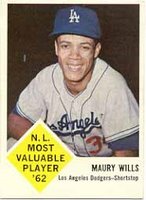
Now for an amazing fact - prior to Larkin, you have to go back 33 years to find another shortstop winning the N.L. MVP, one of the most anomalous MVP awards in baseball history. In 1962, the Dodgers' speedster at short, Maury Wills, stole 104 bases, 72 more than the N.L. base-stealing runner-up that year, his L.A. teammate Willie Davis. It's one of those statistics that just boggles the mind, and it was enough to win him the award (narrowly) over Willie Mays, who put up .304, 141 and 49 numbers that season. You think Matt Holliday is bummed.
Two shortstops won three N.L. MVP's in a row from 1958-1960. Pirates' shortstop Dick Groat won an unlikely MVP in a close and controversial race over his teammate Don Hoak in 1960 (another teammate, Roberto Clemente, finished 8th and made some scathing remarks about the whole vote that almost got him run out Steel Town). And in '58 and '59, Mr. Let's Play Two himself, Ernie Banks, brought back-to-back MVP's to Wrigley.
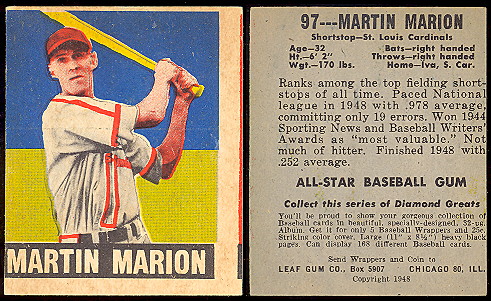
Only one other shortstop remains who won the MVP in the National League, and he's not exactly a household name. In fact, he has to be one of the worst players ever to win the award, which is not to say that he couldn't play, but hell - when they call you the Most Valuable Player after a .267, 63 and 6 season, you just know there's a war on. And so there was in 1944, when the St. Louis Cardinals' SS Marty Marion won the vote over such luminaries as Bill Nicholson, who had a .287, 122 and 33 campaign, and Marion's teammate Stan the Man Musial, who hit .347. Which sort of makes you wonder... exactly how many people did Marty have to blow to get all those MVP votes? Evidently he was a great fielder. But, you know, so was Mark Belanger.
Classic No Mas - THE BAND IS ON THE FIELD! THE BAND IS ON THE FIELD!
(Today is the 25th anniversary of one of the great highlight reels in all of history. Enjoy - L)
November 20, 1982 - A last-second kickoff, about a dozen laterals, a most unlikely touchdown, and one sorryass bandgeek about to get decked. On its 25th anniversary, we here at No Mas invite you to relive the glory of The Play about 20 times.
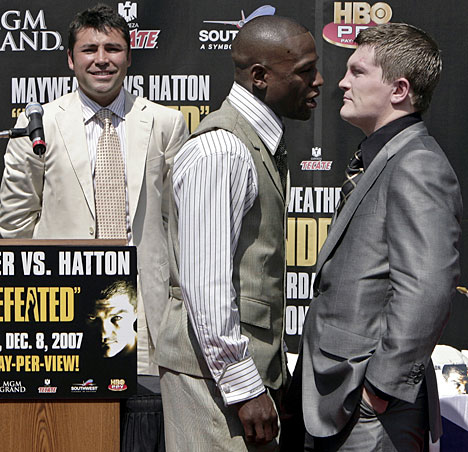
I admit that I was looking forward to the debut of Mayweather/Hattton 24-7 last night. I'm a sucker for big-time fight hype when it's done right, and the De La Hoya/Mayweather series, to my mind, was right as rain. It accomplished everything hype should and at the same time was compelling just as pure documentary. Not to mention that it was a straight-up knockout for the sport of boxing, always welcome in the land of Large.
Based on what I saw last night, Mayweather/Hatton is going to fall quite a bit short of that mark, which is perhaps not so much the fault of the show as the fault of the principals. Floyd is great television, but in small doses. In the De La Hoya series, he was electrifying, and yet it was for most of us a first journey into his strange universe of sociopathic would-be father figures and second childhood fueled by attention deficit disorder and conspicuous bricks of cheddar in every outstretched hand. Revisiting his tiny monarchy of mo' money, even sitting one on one with the King himself in an intimate fireside chat, one can't help but divine the bleeding obvious of Pretty Boy Floyd Mayweather - there's no there there.
Meanwhile, over in Manchester (to borrow the show's default transition), there turns out to be surprisingly less to Ricky Hatton than meets the eye. Watching his performance last night, I was reminded of Martin Amis's Keith Talent from the novel London Fields, an East End swindler of note much enamored of petty larceny, lager and the vicissitudes of the dart-board. The narrator in London Fields ends up taking darts lessons from Keith, and at one point throws the darts to the ground in disgust with his own ineptitude. Instantly, Keith leaps on him and pins him to the dartboard by his neck. "You don't never disrespect the darts mate," he says.
In other words, yes, yes, we get it Rick - you're a regular chap. Where's the darts, innit? Christ has there ever been such a self-conscious Prince of the Pub in all the history of the Empire? Keith Talent was a flipping parody for darts' sake - perpetrating this shtick as some version of reality is really, really not asking very much of your audience. On this score, I fault Hatton and his entourage first and foremost for being so beatifically enamored of his laddishness, but I also fault the producers of the show for letting him get away with it. The virtue of the De La Hoya/Mayweather affair was that it managed to probe beneath each fighter's well-manicured self-presentation. In Floyd's case, four episodes taught me all that I need to know. In that nothing much seems to have changed with him (money=good, dad=crazy), this current series is going to live and die with what Hatton brings to the table. And if that continues to be the documentarian's equivalent of a warm pint and a chippie, well, we're all in for a long fortnight lads, a long fortnight indeed.
Can you imagine what it was like as fight fan to wake up on a Saturday much like this one 25 years ago and to already have witnessed possibly the fight of the 80's the night before, and have a fight ahead of you on Saturday afternoon that would be nearly as great, before becoming an era-defining tragedy destined to permanently change the sport of boxing?
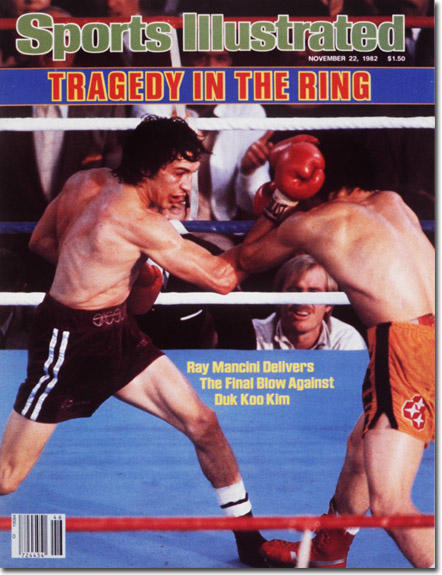
Twenty-five years ago this week, there was indeed such a weekend, two fights in under 24 hours, one in Miami and one in Vegas, that would live forever in fistic lore - Alexis Arguello v. Aaron Pryor I, and Ray Mancini v. Duk Koo Kim.
Were there ever two fights of this historical magnitude in the same weekend? I am not the boxing historian to answer that question, but I would venture to guess that the answer is no. Pryor/Arguello is either the best fight of the 80's or the second best depending on where you rate Leonard/Hearns I from 1981. In my greatest fights of my lifetime piece, I had Leonard/Hearns just above Pryor/Arguello, but it's easy to argue that one either way.
As for Mancini/Kim, well, it's hard to celebrate the greatness of a fight that resulted in a man dying - today is the 25th anniversary of Kim's death from head-wounds endured at the hands of Mancini, a tragedy that would mark the great Boom Boom forever afterwards. ESPN Classic released a one-hour doc this week called Triumph and Tragedy about Mancini's rise to fame and the Kim fight, and in it you must face a stark truth as a fight fan - watching the footage of the bout, it's hard not to be aware that the fight that resulted in Kim's death was a jaw-droppingly great contest, Graziano/Zale, Gatti/Ward, Castillo/Corrales-type material. If Kim had lived, it probably would be mentioned regularly with Leonard/Hearns and Pryor/Arguello as a contender for the greatest fight of the decade. It's just one of those facts that we acolytes of the sweet science must live with in our hearts - we never want anyone to die, but inevitably what we call truly "great" flirts all too closely to the line of death, and sometimes crosses over. As someone once wrote, "I guess there's just a meanness... in this world."
Let me begin by saying that I kind of wish it was Lance. Of course, Lance isn't embroiled in any doping controversy at the moment, and maybe I'm wrong - maybe Lance, like Marion Jones, is too far removed from the public clamor at this point to make the kind of impact that I am looking for in the whole worldwide doping debacle. And what is that impact, you ask? Well, in short, if the steroids-in-sports situation is World War II, right now I'm waiting for Pearl Harbor, and I'm afraid that, huge as it is, the Barry Bonds indictment feels a little more like the Soviet Invasion or the conquest of the Balkans. In other words, big news here in the ole U.S. of A., but not quite big enough to mobilize the Joint Chiefs, not time yet for "we have nothing to fear..."
So much for the military analogy. In plain language, I don't think Bonds resonates enough with people right now to make this the kind of soul-searching, era-defining moment that the steroids epidemic begs for. On that score, it's a shame he's such a dick, because if he provoked any sympathy at all in the public, his whole evil saga would have shocked the shit out of people. As it is, it's merely the whimper of an ending that we've known was coming all along. The helmet's off Darth, big whoop. He's dirtier than dirt, and we all made our peace with that a long time ago, home-run-king or not. That MLB ad that was running seven or eight times an hour all throughout the playoffs, the one with the jingle that still resonates faintly in my ears sometimes and tells me in no uncertain voice to go out into the street and start killing little children and small fluffy animals... that ad carried a not terribly subtle message about Bonds and the home-run record and the state of the national pastime. It began with a child putting a Hank Aaron baseball card up on a ledge and staring at it with all the wonder that his CGI-enhanced eyes could summon. And we all know what the wonder of a child means in the visual vernacular of television. THIS is the real and true legacy of baseball. This is the innocent integrity of our game. For MLB to choose that ad and that image to run incessantly during the postseason while behind the scenes rumors of the Bonds indictment were legion... it was no accident, no indeed.
So who, I wonder, WHO is it that's going to test positive for steroids and by the mere shock of the revelation prompt a paradigm shift? Michael Phelps, right before he wins his eighth gold medal in Beijing? Peyton Manning, right after the Super Bowl? Katie Couric? Oprah? It's hard for me to imagine at this point. Marion Jones came about seven years too late, and the overwhelmingly underwhelming response proves only how short the American attention span is when it comes to track and field and the Olympics. And as I said, the time when a big Lance revelation might have rocked the nation is probably long past as well. In the end, I just don't know who it could be, other than the fact that it ain't Bonds. But I guess that's the way it should be. The knockout punch is almost always the one you don't see coming. Plus, if we'd known the Japanese were going to bomb Pearl Harbor, we would have done something about it, right? Right?
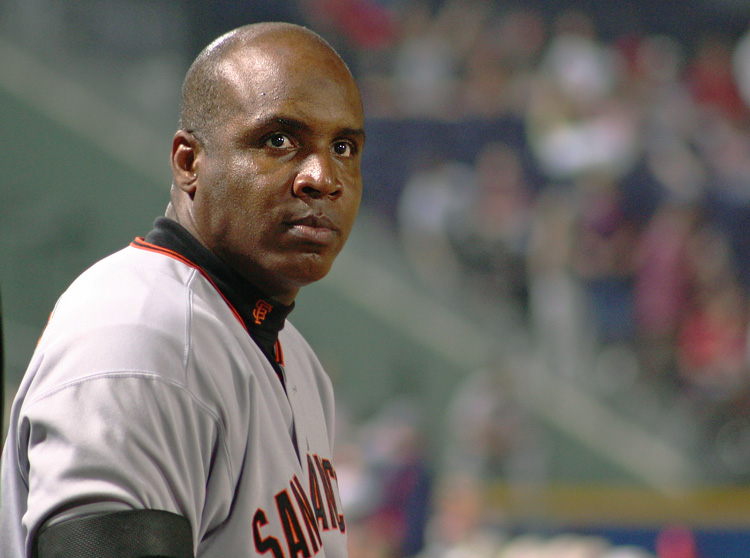
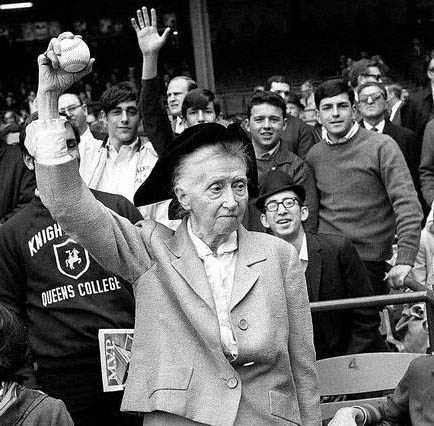
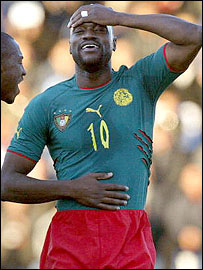
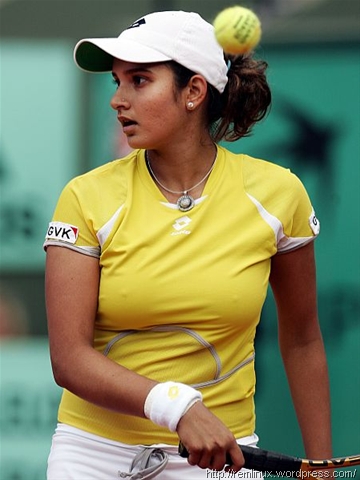
An eclectic crew of birthdays today - two high-scoring now retired footballers, two pioneers of hip hop, two tennis players (one the best and hottest Indian women's player of all time, one the second hottest and second best Spanish men's player alive today), one Australian gold-medal-winning cyclist, one Lebanese rugby legend, one relief-pitching son of a No Mas hero, one point guard turned talking head, one both fine and formidable Mexican golfer, one professional wrestler that many would say is the greatest of all time, and finally, one frail but ferocious female poet who likewise many might say was the greatest of all time, and who once wrote a poem with, well, The Greatest of All Time.
November 14, 1943, sixty-four years ago today, two quarterbacks had remarkable afternoons and set records that still stand to this day.
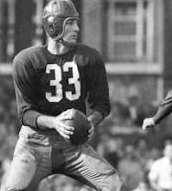
At the Polo Grounds, Sid Luckman led his Chicago Bears to a 56-7 defeat of the New York Giants, at that point the worst drubbing in Giants' history. In the process, Luckman threw seven touchdown passes, a record astonishing for its time, an era of the game when the running game still reigned supreme. Four more quarterbacks have thrown seven TD's in a game, but none have thrown more, and oddly, despite the ascendancy of the air attack and the West Coast offense, no one has done it since Minnesota's Joe Kapp in 1969.
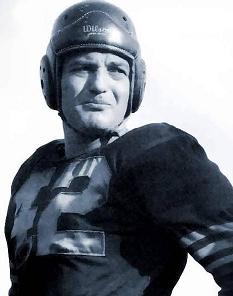
The record that Luckman broke, six touchdown passes in a game, had been set just two weeks prior by Washington's Sammy Baugh. But while Luckman was breaking Baugh's record in New York, Slingin' Sammy was working on a new record of his own down in D.C.'s Griffith Stadium. In the Redskins 42-20 lambasting of the Lions, Baugh threw for four touchdowns and intercepted four passes. Football's greatest generation played the game both ways, and Baugh was not only one of the best quarterbacks of his era, but one of its best defensive backs as well. This 4-and-4 performance is an NFL record that cannot be broken, as much relic as record really, but nonetheless astonishing.
Such is how his Royal Ricky Hatton-ness feels about the fact that David Beckham has announced that he will be in attendance at the Hatton/Floyd fight in December. Evidently it's the first major fight in the life of Prince Beckham. So will Ricky let Becks pop his cherry by carrying the Hatton belts into the ring the way Wayne Rooney did for him in the Castillo fight? Not on, mate, not on. Look, it's not a publicity stunt, is it? Great 'onor 'avin Becks at the fight, but he's not my mate, is he? Wayne Rooney is my bloody good mate, mate. Innit.
All around entertaining Ricky Hatton interview on BBC Sport today, in which he sings his own praise along with those of British boxing in general (the Empire is ascendant, no doubt) and on the whole drops his h's with the working-man's aplomb to which we are accustomed from our Rick. Bloody, wanking bleedin shame it is that he's in for such a beating, says Large, because he's a damn good bloke to have around the miscreant pub that is today's fight scene. In fact, I raise the figurative pint glass in hoping that Oscar takes him on anyway and leaves Cotto to a fight that matters.
Although I consider the first half of the NBA season to officially be the pre-season before the actual season opener (which is of course the All-Star Game) I nevertheless can't help but notice that a certain bunch of four-leaf-clover-eating Micks up in Beantown are 6-0 (I also noticed that they all seem to be black now - dah... hello ghost of Red Auerbach? are you aware of this development?).
As you may be aware, this bunch of leprechaun-jokers used to be a rather formidable side back before IPods, which got me to wondering - when's the last time the Green and White pulled a six-fer to start the season?
Well, as has been widely reported, coincidence would have it that it's exactly 20 seasons ago, when another big three (Jerry Sichting, Brad Lohaus and Artis Gilmore) led the team to a 6-0 start en route to 57 wins and a first-place finish in the Atlantic. This, you will recall, was a turn-the-page season for the Celts and the NBA, as the Pistons finally got over the hump and beat the mighty Bostonians in the conference finals, prompting Kevin McHale to have a famous little passing-the-torch nut-up manchat with Isiah (or was it Dumars?) at midcourt before making for the showers.
Looking back at the Celtics records today, I'm a little surprised to see how tough it actually is to win six to start the season. I figured in their heyday it would have happened almost every year, and yet prior to '87-'88, you have to go back 15 years for another 6-0 (although they did start 17-2 in '85). In '72-'73, the Havlicek/Cowens edition started 10-0 on their way to a 68-14 finish, the best record in the team's glorious history. Unfortunately, for the second year in a row, they ran into Walt, Willis and the rest of the MSG crew in the conference finals, as Red Holzman's Knicks went on to their second NBA Championship in three years.
So thus far, going 6-0 in Boston has equalled a great season with nothing to show for it come trophy-hoisting time. But now, NOW, we get into the salad years. In the ten season span from 1957 to 1967, the Celtics started the season at least 6-0 five times:
In four of those five seasons, they won the NBA title, only losing it in '57-'58 in the finals to Bob Pettit and the St. Louis Hawks. The point being that if this year's edition wants to really channel the glory years, they might want to take it back 40 years, rather than 20. On that score, I simply have to add... Kevin Garnett, we watched Bill Russell... we worship Bill Russell... Kevin Garnett you are NO Bill Russell. (Check out those freaky-deeky Vans-style kicks Bill is wearing in the '68 playoffs up there - meanwhile Wilt is sporting a run-of-the-mill pair of Chucks - I tell you it's the little things that set the truly great ones apart...)
Although it's no news to the devoted follower of the sweet science, I suspect that there's many a casual boxing fan out there who is unaware that James "Buddy" McGirt, now famous as the trainer of Antonio Tarver and Arturo Gatti among others, was once a great fighter in his own right, and possessed of an overall flair and style in the ring that makes him a cinch for the No Mas Hall of Fame. For that reason, I thought it was about time we threw him some love with a starring role in our No Mas Knockout of the Week.
I'm thinking of ole Dirt McGirt today because I recently watched, perhaps for the first time since it actually happened, Buddy's title fight with the great Meldrick Taylor from 1988. This is a lost classic of the 80's, an ABC slugfest that ended with Taylor getting a TKO stoppage over the spent McGirt in the 12th. It was a real coming-out party for Meldrick, with fellow '84 Olympians Pernell Whitaker, Evander Holyfield and Tyrell Biggs all on hand at Harrah's in A.C. to help him celebrate winning his first world title.
Two super-talented '84 gold medalists would prove the thorns in Buddy's career - Meldrick, of course, and then Pernell, who took a title from him in '93 in a thrilling 12-rounder at the Garden. McGirt fought Sweet Pea again in '94 down in Norfolk, and although he went the distance, he was less competitive and lost a lopsided decision. Buddy was a fast, elusive, hard-punching welterweight, but he simply was not in Pernell's elite stratosphere, which is no crime really - few were or ever will be. Also we must remember that by 1994 Buddy was almost a one-fisted fighter, crippled by problems with his left shoulder that plagued him throughout his fighting days.
In '88, however, just prior to the Taylor fight, Buddy still had the left hook to great effect, and wielded it liberally to set up a smashing right-hand knockout of a less-fortunate Olympic opponent, 1976 gold medalist Howard Davis. This was a surprising result, as Davis had fought Meldrick to a draw two years prior, and many expected him to beat McGirt en route to a rematch with Taylor. It wasn't meant to be, however, as you'll see in the video below, the No Mas Knockout of the Week. Enjoy Buddy's shucking and jiving and juking and nuking - man had furious style. Sorry about the overall quality of the vid, but I think you'll forgive that when you hear the announcer's arcane reference to the oh-so-80's movie, Broadcast News. In particular, I know it's going to make the GMan's day...
Classic No Mas - Newsflash: Donovan McNabb Is Allergic to Florida
(Man, if there's one thing I miss about the East Coast right now, it's sports talk radio. Which is a little unfair to Northern California, because I'm sure there are some stations up here where illiterate maniacs with no lives call in and rant about not signing Bonds or Alex Smith or when the hell are they going to play Russell he certainly couldn't do any worse, etc. But see, I just haven't investigated it too much, mostly because I couldn't care less about the 49ers and the Raiders and the Giants. And I suspect, no, KNOW in my heart that there is nothing out here sports-radio-wise to equal the absolutely insane excesses of NYC and Philly. On that score, here's a piece I posted on this day last year, one that I am embarrassed to say fills me with nostalgia for ole Steve Martorano - L) ---------------------------------------------------------------------------------------------
Here's an exchange I just heard on WIP, the main sports radio station in Philly. The hosts of the afternoon show are two dudes with the Philliest possible names imaginable - Steve Martorano and Anthony Gargano:
CALLER: Yo I ain't a doctor but I think I got a serious medical opinion about Donovan McNabb's throwing-up problem.
STEVE: Okay. Let's hear it.
CALLER: Well, all right... the first time it happened was at the Super Bowl in Jacksonville. Then it happened a couple weeks ago in Tampa. And see, I remember Jon Runyan talking about how the air in Florida made his allergies go crazy-
STEVE: I think I see where you're going with this. You think that Donovan McNabb might be allergic to Florida.
CALLER: Well, not exactly. But he's got some kind of allergy problem that-
STEVE: Yeah, yeah, I get it. Donovan McNabb is allergic to Florida. It's an interesting theory.
CALLER: No, Steve, listen I'm serious about this-
STEVE: I'm serious too! I gotta think about it a little more, but you may have just figured out the problem.
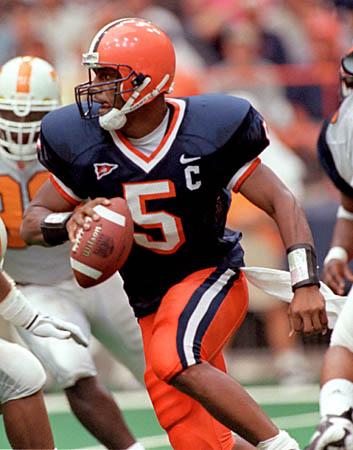
ANTHONY: No look, he didn't figure out the problem. I got something here that's just going to blow this whole theory out the water. Cause McNabb also threw up at the Carrier Dome when he was with Syracuse.
I did an interview with Franchise today over at his site, jarrypark.com. We re-capped the Cotto/Mosley bout (Franchise was actually in the Garden for that one) and the undercards, talked about all the potential bouts out there now for Cotto, and also discussed today's news that Manny Steward will not be training Jermain for the Pavlik rematch in February. Check it out, and check out Chise's site in general. It's a forum for all fight sports, primarily oriented around these pod-cast interviews that he does with internationally renowned impresarios like yours truly.
Twelve years ago today, Dan Marino threw for 333 yards in a 34-17 loss to the Patriots, an unremarkable result made historic for the fact that with those 333 yards Marino passed Fran Tarkenton on the NFL's all-time passing yardage leaderboard.
At that point, Tarkenton's magic number was a paltry 47,003 yards, and the next three quarterbacks rounding out the top five below him and Marino were Dan Fouts (43,040), Joe Montana (40,551) and John Unitas (40,239), with the still active Elway nipping at Johnny U.'s heels.
As of right now, Tarkenton remains in the top five, and seems unlikely to get bumped unless Vinnie T's comeback goes surprisingly well, or until around the middle of the 2009 season, when Peyton Manning will pass him on his way to what undoubtedly will be a serious challenge to Marino's all-time yardage hegemony. Favre, as well, sitting in the two-hole right now, has ole Dapper Dan in his sights, could catch him in fact by season's end, although it will be tight.
Here's the top ten as it stands right now. Keep in mind that Peyton Manning is sitting at eleven with 39,972 yards, and, in yet another insult to Baltimore's wounded soul, could easily knock Unitas out of the top ten next week against the Chiefs.
1. Dan Marino - 61361 2. Brett Favre - 60257 3. John Elway - 51475 4. Warren Moon - 49325 5. Fran Tarkenton - 47003 6. Vinnie Testaverde - 45722 7. Drew Bledsoe - 44611 8. Dan Fouts - 43040 9. Joe Montana - 40551 10. John Unitas - 40239
It's amazing what visual impact the forward momentum of a fighter has on our assessment of a fight's momentum on the whole. The boxer moving forward almost always seems to have fate in his hands, to have mastered the contest of wills that is a fistfight in its purest essence. It is the rare (and by rare, I probably mean phenomenal) talent who can seem to be imposing his will on an opponent while moving backward or consistently circling out of harm's way. Sugar Ray Robinson, Willie Pep, Ali (of course), Ray Leonard, Pernell, and yes, for all you haters out there, a certain Floyd Mayweather. For these geniuses, moving backwards appears to be a question of control and technique, whereas otherwise it almost always seems like a sign of weakness.
There were two very clear turning points in the Mosley/Cotto fight, and I was aware as I noted them what a psychological effect they had on me, which prompted me to wonder if that effect bore any resemblance to the effect that it had on them, the principals. I'm still not sure about this.
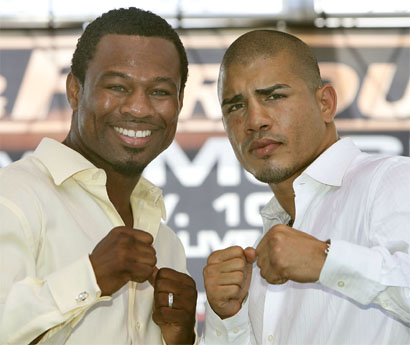
In the middle of the sixth round, after banging away at the center of the ring for the fight's entirety, Sugar Shane got on his bicycle. At the time, his motivation seemed clear. The fight had been to that point a nuclear war of almost unimaginable proportions. Each man had suffered great damage. Halfway through the sixth, Shane blinked, and the staring contest was over. He moved on to plan B, I thought, out of sheer necessity. He'd thought that he had the firepower to outbomb his man, and like so many who have tried that tactic against Cotto, he came out wanting in the arms race. Right then, it seemed a great psychological victory for the Puerto Rican, and gave me the feeling that my prognostification for the fight (Cotto TKO) would come to pass. Shane's had enough of the brutality, I thought - Cotto's done it again.
On to the next turning point, and by far the more puzzling. In the earlygoing of the ninth round, Cotto went into full retreat. This was not in response to a single punch - it was not, in my memory, in response to anything. And it was freakishly disorienting to watch. For as bizarre as it seemed to me, it might as well have been Joe Frazier in there taking to his heels. In the tenth, Shane tried to pounce and press the advantage, and indeed for about thirty seconds it seemed that, mysteriously, Cotto was deeply injured and would soon be knocked out. All I was wondering at that point was "what happened? what's wrong with him?" and all three announcers wondered the same thing.
The only explanation ever offered was that he had a bad cut on the inside of his mouth. Myself, I can't believe that was it. Cotto had a bad, very bloody mouth-cut in the Judah fight, and it affected him in that affair about as much as a canker sore. After the fight, in his broken English, Cotto gave his own explanation for his shift in strategy, and at the same time unwittingly admitted to the fighter's cardinal sin. "I decided to win the fight," he said, "the most easy way for me."
I'm still puzzled. Cotto fought the last third of the fight moving backward, something he's never done before, something that actually seemed contrary to the whole spirit of the man prior to the ninth round Saturday night. To his credit, he was remarkably effective on his heels - I had him winning the 11th cleanly and gave him the narrow edge in an uneventful 12th. And in the end, I agreed that he won the fight, although I would have had no problem with it being called a draw, and I very much wish it had been a split decision. That, I think, would have told the true story, the story of a fight that Cotto won by the skin of his teeth, that was all but an equal contest (unbelievably, Compubox had both fighters landing the exact same numbers of punches over 12 rounds.)
In the final analysis, I confess that I am unsatisfied. Of all the big-name fighters on the scene right now, we are most accustomed to seeing Miguel Cotto break the will of his opponents in victory, and that was anything but the result Saturday night. Unquestionably, that is a testament to the size of the fight in the dog that is Shane Mosley. For him, I have nothing but enormous praise. He endured the standard thrashing that Cotto dishes out to his opponents and kept on coming back for more right to the final bell. Then after the fight he was gracious (as is his wont) and articulate in regards to the decision. It was a superhuman performance for a 36-year-old man, or any man for that matter. To my mind, he is a victor in defeat.
I am tempted to say that Cotto is a slight loser in triumph, although I don't think that is entirely fair. I suspect that Cotto's late retreat was a strategic decision of sorts. Weary of chasing Mosley, weary of eating one overhand right after another, and just weary in general, he said, "okay, I'm ahead now, so you chase me, see how you like it." He possibly recognized that the exhaustion he might endure by pressing the action into the late rounds could make him vulnerable to stoppage (it is infinitely more tiring being the aggressor in the ring). He also, I suspect, faced a fact that as yet he has not had to reckon with in his career - he was in there with a man that he was unlikely to stop. So for once in his gladiatorial career, he yielded the center of the ring and put his back to the ropes. Who knows - it may have won him the fight. But as I said, it was a striking and not altogether welcome sight. It was indeed like seeing Smokin Joe do the rope-a-dope, or Prince Naseem suddenly go into the Mongoose defense, or Sam Malone decide not to bag the stupid bimbo, or Terrell Owens humbly admit his mistakes, or... or... Christ it was like watching the bull snatch the matador's cape and say, "fuck it, you charge for a while." What I'm trying to say is that it just looked wrong, and for that it was hard to come away feeling entirely sanguine about the outcome.
Novelist, journalist, "publicity hound," filmmaker, mayoral candidate, pothead, newspaper entrepreneur, boxing enthusiast... the great Norman Mailer did the unthinkable today, dying in a hospital in Manhattan at the age of 84. He touched my life deeply, and indeed the whole No Masian enterprise, and the news shocks and saddens me. Through reports from I-berg's dad, the august Big Steve, I was aware that Mailer's condition was not good, but nevertheless the idea that such a force of nature actually could pass from the earth always seemed like a longshot.
I can't honestly say that I was a huge fan of Mailer's writing in my lifetime, other than that central work of the No Mas canon, The Fight, and his Pulitzer Prize-winning serio-comic treatment of the 1968 march on the Pentagon, Armies of the Night. Basically, Mailer the Journalist held considerable fascination for me, while Mailer the Novelist struck me as an irreparably flawed enterprise and Mailer the Court Jester made me uncomfortable and often embarrassed.
Then again, Norman Mailer was out to make us uncomfortable, was out to embarrass (both himself and others) and more than anything, was out to compete, and if necessary, fail on the grandest of stages. It's hard to think of another writer in the 20th century who so bullheadedly flew too close to the sun, ignominiously crashed and burned, and then dusted himself off the canvas for another round with that confounded sun. I admit that my tastes are more with Plimpton, his patrician doppleganger, but my "taste" be damned - I think anyway that is my fantasy of myself rather than the most sober self-assessment. If I'm being honest, I know that my heart is with Mailer and always has been. To put it another way, I'm quite sure that if Mailer and not Plimpton had fought those legendary three rounds with Archie Moore at Stillman's Gym, he wouldn't have accepted a broken nose from the Mongoose as some sort of literary badge of honor. He would have been in there to win, and he would fought the bastard all day, God love him. As they carried him out on a stretcher he would have been muttering about a rematch.
Finally, let me say this - whether it's Hemingway, or Mailer, or Plimpton, or Budd Schulberg, or Lord Byron even, who is the Writer King of the No Mas Heap is something that we can sit around and debate for all the Saturday afternoons that are left to us (and we will... we will). But for this man who died today after making such endless drinking, brawling, hard-thinking, tragicomic performance art of his own life, documenting each round that he fought with the Fates like his own personal Ring Encyclopedian... to say that he is a first-ballot No Mas Hall-of-Famer is like saying that Babe Ruth belongs in Cooperstown.
Norman Mailer, Outspoken Novelist, Dies at 84 (nytimes.com)
A lot of people have been asking me for my thoughts on Tuesday night's Contender finale. I suspect that regular No Masians can guess my feelings on that count, but if you want the full scoop, head on over to Jarry Park and listen to my conversation with Franchise. We talk some Calzaghe/Hopkins, the Cotto/Mosley undercard, and I throw a profound lack of love in the direction of my new mortal enemy, one Brian Kenny.
I was interested to see Don Steinberg's piece on ESPN.com yesterday comparing the upcoming Mosley/Cotto showdown to the Pernell/Trinidad fight from 1999. To me, it's one of those comparisons that looks good on paper and yet doesn't stand up to much scrutiny. Yes, there is something to be made of the logistical parallels - the up and coming Puerto Rican superstar versus the aging once-super African-American speed demon. Check. But if you remember that fight at all, you'll certainly remember the main thing there is to remember about it - Sweet Pea had nothing left. I vividly recall watching the first round of that thing and shaking my head in disbelief as the once unhittable Pernell stood flat-footed in front of Tito and took straight one-two's to the face while trying himself to counter with one lonely jab at a time. Pernell already was knee-deep in the blow at that point and bore almost no resemblance to the artful genius he once had been.
Mosley, meanwhile, is a teetotaling fitness freak who is coming off his two best fights in years and who probably will be in as good condition tomorrow night as he was in his signature fight, the first De La Hoya bout in 2000 (here's hoping he's not in quite as good condition as he was in the second De La Hoya fight, when, by his own admission, he was hepped up on BALCO roids).
And Cotto? Well, I know I probably could get myself shot on the south side of Williamsburg for saying this, but in the comfort of my home in Davis, California I feel safe in typing these words - the Miguel Cotto of 2007 would knock out the Tito Trinidad of 1999 in under seven rounds.
I expect to see an exiciting fight tomorrow night, a fight that I won't be surprised to see mirror the Cotto/Judah affair, which certainly bodes well for us fans. Age will play a factor I believe for Sugar Shane, for though he remains in crack physical condition, the deterioration of the reflexes is not something that you can stave off with diet and exercise. Shane Mosley today is a boxer who has to get hit if he wants to trade, and the exchange rate will not favor him in the least. In the early rounds, however, look for him to be impressive with the shoeshine combinations that are his trademark, and even stun Cotto with some big shots in the same way that Judah did. It will take Cotto at least three rounds to adjust to Shane's speed, and during that time I imagine he'll get outlanded by Mosley at around a three-to-one ratio.
That one, though - that one makes all the difference. Cotto is not a one-punch knockout artist in the Tito tradition by any means. But he does finish what he starts with remarkable efficiency, and the key to his attack is that his knockout punch in the ninth is frequently a right hook to the kidneys that he threw in the fourth. No boxer on the scene today is as devoted an adherent to the "kill the body and the head will die" orthodoxy as is Cotto, and it's a creed that has served him well (let's be honest - it seems to serve all of its apostles well, which makes you wonder why its flock is so meager).
We boxing fans overuse the term "throwback fighter" and yet Cotto to me deserves the honorable title more than anyone on the scene today. It's easy to imagine him doing battle with the great welterweights of the 40's and 50's, the Robinsons and Basilios and DeMarcos and Gavilans. His brand of ruggedness is straight out of the old school - his approach as well. Somehow (possibly in his own promotional interests) he's gained the reputation of a brawler with all that the term tends to connote - plodding, wild, devoid of subtlety. This is anything but the true nature of Miguel Cotto in the ring. He's mobile, he's artful, he's thoughtful. But he's also fiercely interested in combat, an offense-first sort of fellow, and this is what really hearkens to another era. Much of the hype for this bout has pitted the boxer-puncher legend versus the upstart brawler, and yet to my mind the true boxer-puncher, or should I say puncher-boxer, in this fight is not Mosley but Cotto. This will tell the tale in the end. Much like Zab, I think Shane will find by the middle rounds that he simply can't get away from his man, and that he simply can't take much more of the brutality. I see a spirited, bloody road ahead that in the end will stretch as long as Shane's moxie will allow, and I'm willing to bet that it doesn't allow anything beyond the tenth, proud and game though I know him to be. So that's my prognostification, people - Cotto TKO 10. Word is bond.
(p.s. Nice undercard for this one - pay close attention to Margarito trying to get back to form after the Williams fight. The early word is that if Cotto wins, Margarito is his next fight. Casamayor is on the card as well in his first fight since his win over the late Chico Corrales last October. Finally, take a look at Victor Ortiz, a highly-touted 147 making a step-up fight against Ole Gumby himself, Carlos Maussa.)
I submit for your approval the motley crüe below, all born today - five major leaguers (a World Series winning manager, a Cy Young winner, a stalwart shortstop, a bat-wielding maniac and Oh Henry himself), four footballers (the Irish captain, the Brazilian jaw, the Asian Maradona and a great lover of Page 3) along with a treble-winning football manager, two track-and-field athletes (a gold-medalist at Antwerp and the current women's high-jump world champion), the most victorious Dutch cyclist in history, the only Puerto Rican in the Horse Racing Hall of Fame, Stanford's all-time assist king, Australia's finest fast bowler, and the most expensive pair of legs never to set foot on an athletic pitch of any kind.
Here at No Mas we're very interested in those sporting events that intersect with the world at large, times when the cloistered microcosm of athletes and their deeds provides a prism unto a wider sociocultural moment.
If ever there was such a time, it was on this day 16 years ago when Magic Johnson first told the world that he was HIV positive and retiring from basketball. It's a moment that remains indelibly imprinted on the memory of anyone who lived through it, one of those news-story shocks that hits you like a shot to the gut, that feels so personal that it might as well have happened to someone you intimately know rather than a media figure you've only watched on television.
Watching this press conference in retrospect, I'm simply amazed at Magic's calm and ease at the podium. It's this kind of presence of mind and faith in himself and fate that clearly was part of what made him such a wondrous athlete in the first place. Magic's courage and down-to-earth openness in facing his diagnosis inaugurated a new phase in the American public's awareness of HIV and AIDS, and for that he has been deservedly commended.
I can't help but imagine, however, how the gay community must have felt about Johnson's revelation and its perceived effect on mass culture's relationship to the virus. The larger-than-life aspect of sport never seemed so fraught with contradiction. Its power to influence our lives and opinions is unquestionable, but why do we grant it such power? In other words, why, after a decade of helplessness and death, an entire generation of sudden disappearances, why was an already genocidal epidemic suddenly more vivid and tragic when it found its way into the blood of a beloved heterosexual athlete?
K.O.W. - Portrait of the Artist after a Clean Shot to the Liver
In that Shane Mosley already has figured in one of our K.O.W.'s (a real gem too - Mosley v. Gomez, 1997), and mysteriously, Miguel Cotto has not, our Knockout of the Week is a lay-up. I take you back two years to a crossroads in Cotto's rising career, a fight in September of '05 against the lightly regarded Colombian Ricardo Torres, the first undercard of the heavily hyped Wlad Klitschko/Sam Peter bout in A.C. Large was in attendance for this one, along for the ride with our soul brother number one, Aaron Cohen. I confess that I was expecting to see nothing more from the undercard than some routine ultra-violence from Cotto. What I got instead was ultra-violent viddies from both of the principals in a gutcheck smackdown that, had it not occurred in 2005, would have been a cinch for Fight of Any Other Year (there was the small matter in '05, you will recall, of Castillo/Corrales I).
It was all-out nuclear war from the opening bell. Seven knockdowns were registered in all, 5-2 in favor of Cotto, and yet that does not even tell the tale, because Cotto took a liver-shot in the first round that bent him at the waist and opened him to a blistering flurry of bombs. This in my memory was the most danger he faced in the fight, and he had two trips to the canvas still ahead of him.
I've attached the last two minutes of the seventh round, but if you're a devotee of the fistic arts and you've never seen this thing, you might as well take a half-hour and check it out in full on YouTube. As Harold Lederman says below, five of the first six rounds were 10-8's, which pretty much tells you everything you need to know. This is a central exhibit in the canon of Cotto - like all young dynamos, eventually he was going to face some journeyman hardhead who more than makes up for his lack of natural ability with an utter absence of fear in his heart for any man alive. Torres was such a man, and when Cotto approached him with the expectation that he would fold from the mere force of his will, Torres shocked the Puerto Rican wunderkind by matching that force and even raising its intensity. At that point, Cotto, visibly unprepared for such a contest, might have packed it in, a result that would have been devastating to his development as a superstar. Instead, he called on his inner resources and persevered through his greatest test to date.
(p.s. - I'll be previewing Cotto/Mosley in full this Friday, with a prognostification that will call the result right down the ROUND. Word is bond...)
"...the matador, if he knows his profession, can increase the amount of danger of death that he runs exactly as much as he wishes. He should, however, increase this danger, within the rules provided for his protection. In other words it is to his credit if he does something that he knows how to do in a highly dangerous but still geometrically possible manner. It is to his discredit is he runs danger through ignorance, through disregard of the fundamental rules, through physical or mental slowness, or through blind folly."
As far as I'm concerned, the best book ever written about boxing is Death in the Afternoon, which, of course, is Hemingway's classic combination memoir and textbook of bullfighting. Just about every passage seems to have great bearing on the sweet science, and it's clear reading it that Papa's aesthetics were consistent throughout both of his bloody preoccupations.
I thought about passages like the one above, and many others extolling the virtues of the artfully dangerous matador, while I watched Joe Calzaghe on Saturday night, dismantling a fearsome and ferocious opponent in a display of courage and skill that for me was almost as much performance art as it was sport.
What was so compelling about Calzaghe's approach was the sense that he courted danger right to the edge of the point at which it was bearable, and then drew back before sallying forth for another death-defying pass through the lion's maw. Early in the bout, about the third round or so, I was certain that Mikkel Kessler was going to knock Calzaghe out. In fact, the fight reminded me at that point of the early stages of the Taylor/Pavlik fight, without the knockdown. Like Taylor, Calzaghe fought awkwardly and frenetically at first, to the pleasure of the crowd but to little real avail with his opponent. Meanwhile, Kessler, like Pavlik, comfortably measured his laser-like right hand, which, when it landed, landed with frightening effect. The Welshman ate an uppercut in the third round that might have decapitated him. That he was merely stunned, that ten seconds later he was whipping off a five-punch combination, seemed to me at the time to be a feat of magic worthy of Houdini.
After that shot I thought to myself, it's only a matter of time. One more of those and they'll be scraping him off the canvas. Two more of those and we'll have a dead man on our hands.
By the end of the fight, I'd venture to say Calzaghe had absorbed maybe five more such blows, and yet by the end of the fight it was clear that Calzaghe was indeed a magician. Somewhere in the middle of the fourth round, he completely solved the Great Dane, and then the show was on. At one point, his dad/trainer, Enzo Calzaghe, said something to the effect of "son it's time to shine now," and it was if a switch had been flicked. Such a dizzying array of punches, such impossible angles, and such narrow margins of error I have not seen since the heyday of Ray Leonard. Once Kessler realized that he did not have a chance to win the fight on points (which he realized early, maybe by the eighth), he started to throw punches with truly bad intentions, and Kessler, like Pavlik, is a born puncher. Still, Calzaghe waded forward, walked the tightrope, dodged the bombs by a hair's width and then launched another four, or seven, or nine-punch flurry. I'm telling you the man was like Henry Armstrong crossed with Evel Knievel. I love violent fights and still there were times when I almost couldn't watch, because the clearcut winner of the thing seemed so goddamn close to death over and over again that the dread anticipation was just too much to take.
Of course, there was no cause for my anxiety, because like Hemingway's ideal toreador, Calzaghe was well within himself, measuring his risk against the awesome reward of a single perfect performance, allowing for the maximum amount of danger while remaining in complete and utter control of the situation. It was exhilirating, everything you want to see from a fighter, mastery of his art, bravery bordering on absurdity and a sense of theater to appease even the angriest gods. Afterwards, in his interview with Max Kellerman, despite his habitual modesty, I thought Calzaghe beamed with the awareness of his accomplishment, and Kessler too seemed compliant in the moment, shaking his head with the resignation of a great man who knows he has been blindsided by forces beyond his control.
If you like boxing, and you missed this fight, then do whatever you have to do to see it. You won't regret it. If you think I'm overstating the case, consider this: After one particularly thrilling round - I think it was the eighth - I heard one set of hands clapping particularly hard amidst the general clamor, clapping as if they were doing it right into one of the HBO microphones. Who the hell is that, I thought, and then Lampley told us. It was his right-hand man, Manny Steward, joining in the standing ovation. And you know Manny Steward don't stand up and clap for no average-ass run-of-the-mill bullshit.
I once asked Larry Holmes who hit him the hardest of all the fighters he faced in his career. He thought about it for a second. The first name he came out with was Mike Weaver. Then he brought up Joe Frazier, who he'd sparred with in his early days. "He broke my ribs once in a sparring session," he said. "He didn't know nothing about taking it easy. Every time he hit you it was like he was trying to kill you."
When I asked him what Ali's power felt like, he talked for a while about sparring with The Greatest before the Rumble. "It was strange with Muhammad," he said. "When I first got in the ring with him I was all nervous and shit, and then he stuck a couple of jabs in my face and I thought, "okay, I can handle this," and then the right hands start coming and I'm still like, "yeah, yeah, I'm still here," but then, you know, after three rounds of that shit my face is all fucked up and I'm bleeding from some cuts and I catch a look at myself in a mirror and I'm all swollen and I'm thinking, "when the fuck did THAT happen?"
I thought about that story last night while I was watching the Calvin Brock/Eddie Chambers fight, which Chambers won in a narrow split decision that was to my eyes not nearly as close as the judges saw it. Some guys, even when they don't have knockout power, just seem to have a way of slicing you up, and Chambers certainly did that to Brock last night. He fought a maddening fight at times, and yet I think that you only need to take one look at Brock's horrifying knockout of Zuri Lawrence in 2006 for a clue as to what motivated Chambers' cagey approach. Whatever Brock's many faults in the ring, one thing is certain - he can fell a hippopotamus with one clean shot. Despite the fact that he was on Showtime last night, with a shot at the big money lying in the balance, I think Fast Eddie was content to be fast and loose rather than great against a man who can bring such thunder.
Not that Brock was looking too thunderous on the whole. Sheesh. Man looked like he ate the damn bank. I think we can bid farewell to Calvin once and for all after that one. As for Eddie's hopes against Alexander Povetkin, I think they are good. He'll be an underdog, but it should be an entertaining, bull/matador-ish affair. Povetkin is ultimately a much more exciting opponent for Klitschko than Chambers - there's no doubt about that. Last night's display did nothing to make me think that Eddie has a chance against Wlad the (One-Two) Impaler. Just the idea of the 6'6", 245 Klitschko going after the 6'1", 210 Chambers conjures the image of a glorified fox-hunt rather than a heavyweight title fight. If it ever comes off, they should put Pavlik/Pacquiao on the undercard. Maybe if Eddie were a little more seasoned, I would rate his chances higher, but on that score, I have to confess that I found myself wondering last night what would happen if Chambers fought Chris Byrd right now. Honestly, I'm not sure he would win that fight. In other words, Fast Eddie, if you do make it into the ring against the Klitsch, you might want to think about getting a HELL of a lot faster.
Joe Calzaghe v. Mikkel Kessler Millennium Stadium - Cardiff, Wales HBO, 9 p.m. EST WBC, WBO and WBA supermiddleweight belts at stake
Despite his massive Welsh pride, Calzaghe is one of those guys who has to wish he was American right about now. Were he a Yank, he would be the biggest star in boxing today by far, even potentially a crossover mega-star to rival Tyson, or at least Roy Jones. I mean - a dark, handsome undefeated white southpaw with Luke Perry's sideburns and Meldrick Taylor's handspeed? Guy would have been the MACK Stateside. Probably be married to Lil Kim by now.
As it is, though, he has the love of his countryman ("what's the booty of Lil Kim compared to the love of my people?") and the rolling green hills and he's made a nice living for himself claiming ownership of the 168 division for ten full years. It's an accomplishment that should land him in the Hall of Fame. I say "should" for two reasons - super-middleweight never has been a glamor division, and Calzaghe has not a single name on his roster of defeats that inspires awe, except, perhaps, for Miguel Angel Jimenez. And I don't know about you, but to me beating up a great Spanish golfer sounds like little more than a publicity stunt.
No, sadly, the Robin Reids and Chris Eubanks of the world do not send a shiver down the American fight-fan's spine, and despite the fact that Calzaghe pulverized the American we recently sent over there to take his crown, we've long made our peace with the fact that that American was perhaps not our soundest export. At this late stage of his career, when you would expect such a decorated veteran as Calzaghe to be fighting huge PPV fights to solidify his legacy once and for all, he's just not been able to summon the talent into the ring. His last two bouts have been against Contender fighters. He had a tough time getting past one of them.
His opponent tomorrow night is unquestionably the best fighter he's ever faced, Denmark's Mikkel Kessler, The Viking Warrior (I've decided this nickname is, in fact, awesome - I should note here that at one time in his career, Calzaghe, who now fights as The Pride of Wales, called himself The Italian Dragon - myself, I think he should bring that back just for one fight to make this showdown truly worthy of Nintendo). I've been reading analysis of this fight all week that focused on Kessler's vaunted defensive prowess, and I must say, I just don't see it. The most recent Kessler fight that I saw was against the German Markus Beyer, from whom Kessler seized the WBC belt that he wears into the Calzaghe bout. The Viking was impressive, but in that way that fighters are always impressive when they are fighting someone who should not have dared to enter the ring with them. The main thing I noticed was that Kessler held his right almost down at his chest. Beyer, like Calzaghe, is a southpaw, and the left-hand lead was as open for him as a roadside Denny's at 4 a.m. He did not avail himself much of the opportunity - Calzaghe, I suspect, will not be so obliging.
What makes this fight exciting is that there's so much at stake for both principals. Kessler is 28, and this is the moment his entire career has been building towards - in that way he feels right now like the Danish Kelly Pavlik going into his fight with a Welsh Jermain. For Calzaghe, on the other hand, despite ten years at the top of the division, he's still fighting for respect, and for the chance at a massive payday here in the States. If he loses to Kessler, he will lose considerable amounts of esteem, haunted forever by the claim that he never fought anyone worth a damn, and when he finally did, he melted like a nice gooey Welsh rarebit left a smidge too long on the grill. If he wins, however, he may at last have enough clout in the U.S. arena to get the fight with Hopkins that has been talked about for so long. To make that happen, though, he can't just win by getting on his bicycle and outpointing the Viking. That's why the only prognostification I'm going to offer here is for a bonafide bloodfest. I really don't have a feel for who's going to win this fight - I can see it going either way. But I do feel almost certain that it will be a donnybrook of sizable proportions. The Viking Warrior has never shied away from a brawl, and Calzaghe simply can't afford to stay out of the fray.
p.s. Two other fights this weekend with big implications for future bouts. Tomorrow night on Showtime, Juan Manuel Marquez puts his WBC super-featherweight title on the line against a tough little bastard from Houston, Rocky Juarez. More than the alphabet belt, what's really at stake in this fight is a potential big-money rematch for Marquez against Manny Pacquiao, who he fought to a thrilling draw in 2004 after tasting the canvas three times in a perilous first round. Marquez has a habit of fighting up or down to his competition, and he better not be taking Juarez lightly, for this is the same Juarez who nearly defeated Marco Antonio Barrera in May of '06 when Barrrera dared to brawl with him. I fear an upset is in the making in this one - Marquez has been through some wars, and valiant though he has seemed of late, Juarez feels to me like exactly the rugged sort of fighter to capitalize on a softened opponent who underestimates him. The other fight worthy of our attention is a heavywight title eliminator tonight in Tacoma between Calvin Brock and Fast Eddie Chambers. Most of you No Masians are aware that I am a Brock fan, but tonight my sympathies will be with Chambers, a Philly fighter making a huge step up in competition. I'm hoping (far from certain on this one) that Fast Eddie has the skills to put a solid American name back into the heavyweight mix. Tonight's winner earns a bout with Alexander Povetkin, and the winner of that fight will fight Klitschko for his IBF belt.
 Lot of big name fighters in action this weekend - Antonio Tarver, Vernon Forrest, Chavez Jr., Jorge Arce, even ole Chop Chop Corley, who fights tonight in Miami. None of these fights, however, include top-notch opponents, and so are mostly biding-their-time, cashing-that-check type fights, especially for Chavez, who fights tomorrow night on flippin PPV against Ray Sanchez, a fact that should give you some idea of what kind of pull the name "Chavez" has in the Mexican boxing universe.
 Well, see, it all went down like this - Martin fought in a charity boxing match where Hearns happened to be a celebrity judge. After stomping his man mercilessly (poor form for a charity event, but hey, that's how the Raw Dog DO), Martin threw an afterparty for himself back at his crib. Hearns showed up, disrespected the Raw Dog, and then proceeded to hit on Mardy-Mar's lady, the stupid fineness highness that is Gina. Still juiced from his big KO, Martin takes offense. After slinging a few choice insults ("They call you the Hitman? Well I just got a call from Sugar Ray... he calls you the GET Hit Man!") he challenges him to a fight, and it's ON.