The Nobel Sports Prize
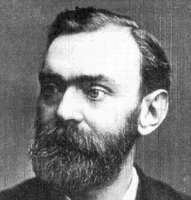
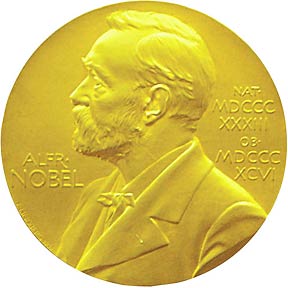
On this day in 1895, an enormously wealthy Swedish Renaissance man who, among his many accomplishments, invented dynamite, signed his last will and testament at the Swedish-Norwegian club in Paris, thereby dedicating a large portion of his fortune to creating what would become over the course of the next century the most famous and prestigious prizes in the world. Alfred Nobel died of a stroke just over a year after signing the crucial document - the first Nobel Prizes were awarded five years after that, in 1901.
A much lamented oversight on Nobel's part here at No Mas, there was no provision made in his will to provide for a Prize in the Field of Athletic Achievement. Nevertheless, among the various winners in the other categories - Physics, Chemistry, Medicine, Literature and Peace - there have been many a notable sportsman and important sporting connections. I will list just a few of these below, with the initial assertion that no, Johnny Unitas did NOT win a Nobel Prize in Anything despite what you or I might have been taught, and a further caveat that I am far more familiar with the Peace and Literature wings of this particular Hall of Fame than those other complicated scientific endeavors:
It's ironic that Mr. Big Stick himself won the Nobel Peace Prize, but indeed he did, for brokering the Treaty of Portsmouth that ended the Russo-Japanese War. Of course, most of the rest of Teddy's life was dedicated to unbridled combat and killing. He was an avid big-game hunter and pursued the fistic arts throughout his life as a form of spirited recreation. Overcoming a sickly childhood, Roosevelt became a prize-winning pugilist as a youth, and was the runner-up in the Harvard boxing championship of 1880.
 1907 - Rudyard Kipling - Literature
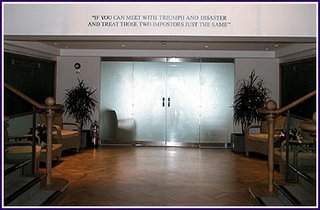
Despite pretty much inventing in poetry and prose the stiff-upper-lip code of manhood that has loomed as the lofty ideal for all of John Bull's affairs, sporting and otherwise, ever since, Kipling's most important athletic contribution are undoubtedly the words of his rah-rah poem, "If", that today are writ large above the entrance at Wimbledon through which the players pass onto Centre Court:
1907 - Rudyard Kipling - LiteratureDespite pretty much inventing in poetry and prose the stiff-upper-lip code of manhood that has loomed as the lofty ideal for all of John Bull's affairs, sporting and otherwise, ever since, Kipling's most important athletic contribution are undoubtedly the words of his rah-rah poem, "If", that today are writ large above the entrance at Wimbledon through which the players pass onto Centre Court:
If you can meet with triumph and disaster
And treat those two impostors just the same
1922 - Niels Bohr - Physics
One of the giants of 20th century physics who would later become famous as a mastermind of the Manhattan Project, Bohr won the Nobel in 1922 for his model of the atomic structure. Bohr's lesser-known brother, Harald, with whom Niels was very close throughout their entire lives, was a Danish football star, and played on Denmark's Olympic squad at the 1908 Olympics in London, where he won a silver medal.
 1923 - W.B. Yeats - Literature
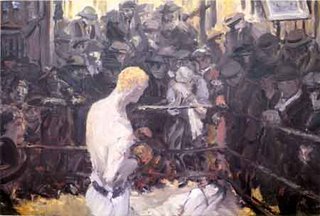
The ur-Irish poet was a known fan of the sweet science, as was his brother, the artist Jack Butler Yeats, who painted a beloved No Masian masterpiece, The Small Ring (pictured right) in 1930.
1925 - George Bernard Shaw - Literature
Also a sweet scientist of note, the famous Irish playwright wrote a hilarious novel about a fighter trying to woo an aristocrat called Cashel Byron's Profession. Later on in his life, Shaw became a mentor of sorts to the boxer-scholar of note, Gene Tunney - the two were lifelong friends and correspondents.
1929 - Frederick Hopkins - Medicine
Sir Frederick made quite a major contribution to the future of nutrition - he discovered vitamins. He also discovered that repetitive muscle contraction leads to the production of lactic acid, the prevention of which has been a focal point of endurance athletes ever since. But it is for his work on vitamins that Hopkins won the Nobel, and also for which I mention him here, because without vitamins and the subsequent universe of dubious nutritional supplements, where on earth would today's sports figures turn for an alibi when they are caught using steroids?
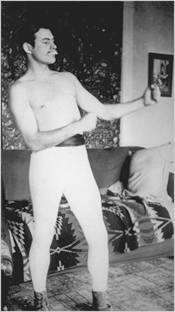 1952 - Ernest Hemingway - Literature
I imagine, if you have even a passing familiarity with No Mas, you are aware of our position on Papa. He basically established the blueprint for our entire project, one that begins with, as I have written before, a requisite fascination with the three b's - baseball, boxing and bullfighting (the photograph on the left is Hemingway as a young ex-pat in Paris, where he often rented himself out as a sparring partner to make ends meet). More than maybe any other literary figure in history (Lord Byron? Virgil?), Hemingway illustrated that the sporting life and the life of the mind are in no way mutually exclusive. For that alone, he is our patron saint. One final note - it was the publication of The Old Man and the Sea that finally tipped the Nobel scale in Papa's favor, that novel in which he mythologized Joe D, "the great DiMaggio," long before the leggy Mrs. Robinson was even a twinkle in Paul Simon's eye.
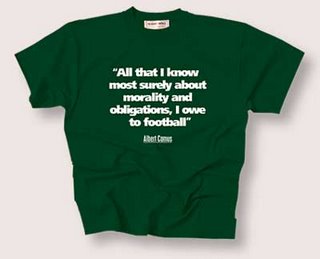 1957 - Albert Camus - Literature
As a young man in Algeria, Camus was a great footballer, a goaltender. His days on the pitch, however, were scotched by a bout of TB that he contracted in 1930. I include Camus because of an exchange I once had with an elderly editor at Columbia University Press when I was working there. While discussing Camus, this chap made a remark along the lines of "well, I guess we have tuberculosis to thank for giving us one of the greatest authors of the century." I vividly remember thinking, "yeah, but we also have it to thank for taking away a great footballer, so what's the bloody bleedin difference?" On this score, when once asked which he more preferred, football or the theater, Camus replied, "Football, without hesitation", a quote that I must say I prefer to his far more popular jersey slogan - "All that I know most surely about morality and obligations, I owe to football."
1962 - Max Perutz - Chemistry
Perutz is best known for supervising James Watson and Francis Crick in their breakthrough experiments that ultimately determined the structure of DNA. But Perutz himself won the Nobel due to his explanation of the molecular structure of hemoglobin, which is the oxygen-transporting protein in red blood cells. Without this work, there would today be no blood doping, no EPO, and consequently no one would have won the Tour de France in the last 30 years.
1969 - Samuel Beckett - Literature
Waiting for Godot and a slew of hilarious though largely incomprehensible novels are not the only claims to fame for this iconic Irish author. He is also the only Nobel laureate in history to have his own entry in the Wisden Cricketers' Almanack (for you unknowing No Masians, this is to cricket what the Ring Encyclopedia once was to boxing). Beckett was both an accomplished batsman and bowler at Dublin University.
1970 - Norman Borlaug - Peace
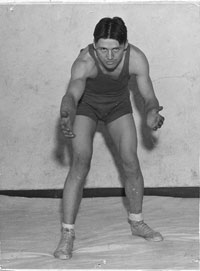 An agricultural scientist and humanitarian giant, Borlaug won the Peace Prize in 1970 for his tireless work to decrease world famine. Among his many honors are the Presidential Medal of Freedom, the Congressional Gold Medal and enshrinement in the National Wrestling Hall of Fame in Stillwater, Oklahoma. While a student at the University of Minnesota, Borlaug (pictured on the right in his grappling days) was a championship wrestler, and reached the Big Ten semifinals in 1937. While still in college, Borlaug organized the high school program in Minnesota and served as a referee in the first regional and state tournaments.
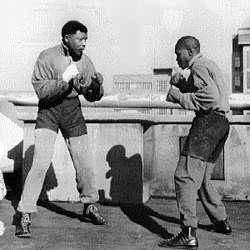
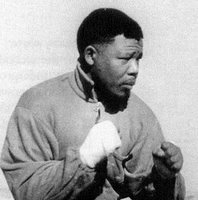
1993 - Nelson Mandela - Peace
Mandela was a boxer as a young man, and later would write eloquently of his love of the sport in his autobiography: "I was never an outstanding boxer. I was in the heavyweight division, and I had neither enough power to compensate for my lack of speed nor enough speed to make up for my lack of power. I did not enjoy the violence of boxing so much as the science of it. I was intrigued by how one moved one's body to protect oneself, how one used a strategy both to attack and retreat, how one paced oneself over a match. Boxing is egalitarian. In the ring, rank, age, color, and wealth are irrelevant. When you are circling your opponent, probing his strengths and weaknesses, you are not thinking about his color or social status."
2005 - Harold Pinter - Literature
This English playwright is famously obsessed with the sport of cricket, a lifetime fan of the Yorkshire Cricket Club and chairman of the Gaieties Cricket Club (whatever the bloody hell that is). There are frequent references to the sport in his work, and in his house, he evidently has a life-size portrait of himself as a younger man swinging a cricket bat. Also, Pinter wrote a well-known poem about the post-war legend Len Hutton, (pictured right) a poem that in only two lines seems to say about all there is to say about growing old and nostalgic as a sports fan:
And treat those two impostors just the same
1922 - Niels Bohr - Physics
One of the giants of 20th century physics who would later become famous as a mastermind of the Manhattan Project, Bohr won the Nobel in 1922 for his model of the atomic structure. Bohr's lesser-known brother, Harald, with whom Niels was very close throughout their entire lives, was a Danish football star, and played on Denmark's Olympic squad at the 1908 Olympics in London, where he won a silver medal.
1923 - W.B. Yeats - LiteratureThe ur-Irish poet was a known fan of the sweet science, as was his brother, the artist Jack Butler Yeats, who painted a beloved No Masian masterpiece, The Small Ring (pictured right) in 1930.
1925 - George Bernard Shaw - Literature
Also a sweet scientist of note, the famous Irish playwright wrote a hilarious novel about a fighter trying to woo an aristocrat called Cashel Byron's Profession. Later on in his life, Shaw became a mentor of sorts to the boxer-scholar of note, Gene Tunney - the two were lifelong friends and correspondents.
1929 - Frederick Hopkins - Medicine
Sir Frederick made quite a major contribution to the future of nutrition - he discovered vitamins. He also discovered that repetitive muscle contraction leads to the production of lactic acid, the prevention of which has been a focal point of endurance athletes ever since. But it is for his work on vitamins that Hopkins won the Nobel, and also for which I mention him here, because without vitamins and the subsequent universe of dubious nutritional supplements, where on earth would today's sports figures turn for an alibi when they are caught using steroids?
1952 - Ernest Hemingway - LiteratureI imagine, if you have even a passing familiarity with No Mas, you are aware of our position on Papa. He basically established the blueprint for our entire project, one that begins with, as I have written before, a requisite fascination with the three b's - baseball, boxing and bullfighting (the photograph on the left is Hemingway as a young ex-pat in Paris, where he often rented himself out as a sparring partner to make ends meet). More than maybe any other literary figure in history (Lord Byron? Virgil?), Hemingway illustrated that the sporting life and the life of the mind are in no way mutually exclusive. For that alone, he is our patron saint. One final note - it was the publication of The Old Man and the Sea that finally tipped the Nobel scale in Papa's favor, that novel in which he mythologized Joe D, "the great DiMaggio," long before the leggy Mrs. Robinson was even a twinkle in Paul Simon's eye.
1957 - Albert Camus - LiteratureAs a young man in Algeria, Camus was a great footballer, a goaltender. His days on the pitch, however, were scotched by a bout of TB that he contracted in 1930. I include Camus because of an exchange I once had with an elderly editor at Columbia University Press when I was working there. While discussing Camus, this chap made a remark along the lines of "well, I guess we have tuberculosis to thank for giving us one of the greatest authors of the century." I vividly remember thinking, "yeah, but we also have it to thank for taking away a great footballer, so what's the bloody bleedin difference?" On this score, when once asked which he more preferred, football or the theater, Camus replied, "Football, without hesitation", a quote that I must say I prefer to his far more popular jersey slogan - "All that I know most surely about morality and obligations, I owe to football."
1962 - Max Perutz - Chemistry
Perutz is best known for supervising James Watson and Francis Crick in their breakthrough experiments that ultimately determined the structure of DNA. But Perutz himself won the Nobel due to his explanation of the molecular structure of hemoglobin, which is the oxygen-transporting protein in red blood cells. Without this work, there would today be no blood doping, no EPO, and consequently no one would have won the Tour de France in the last 30 years.
1969 - Samuel Beckett - Literature
Waiting for Godot and a slew of hilarious though largely incomprehensible novels are not the only claims to fame for this iconic Irish author. He is also the only Nobel laureate in history to have his own entry in the Wisden Cricketers' Almanack (for you unknowing No Masians, this is to cricket what the Ring Encyclopedia once was to boxing). Beckett was both an accomplished batsman and bowler at Dublin University.
1970 - Norman Borlaug - Peace
An agricultural scientist and humanitarian giant, Borlaug won the Peace Prize in 1970 for his tireless work to decrease world famine. Among his many honors are the Presidential Medal of Freedom, the Congressional Gold Medal and enshrinement in the National Wrestling Hall of Fame in Stillwater, Oklahoma. While a student at the University of Minnesota, Borlaug (pictured on the right in his grappling days) was a championship wrestler, and reached the Big Ten semifinals in 1937. While still in college, Borlaug organized the high school program in Minnesota and served as a referee in the first regional and state tournaments.1993 - Nelson Mandela - Peace
Mandela was a boxer as a young man, and later would write eloquently of his love of the sport in his autobiography: "I was never an outstanding boxer. I was in the heavyweight division, and I had neither enough power to compensate for my lack of speed nor enough speed to make up for my lack of power. I did not enjoy the violence of boxing so much as the science of it. I was intrigued by how one moved one's body to protect oneself, how one used a strategy both to attack and retreat, how one paced oneself over a match. Boxing is egalitarian. In the ring, rank, age, color, and wealth are irrelevant. When you are circling your opponent, probing his strengths and weaknesses, you are not thinking about his color or social status."
2005 - Harold Pinter - Literature
This English playwright is famously obsessed with the sport of cricket, a lifetime fan of the Yorkshire Cricket Club and chairman of the Gaieties Cricket Club (whatever the bloody hell that is). There are frequent references to the sport in his work, and in his house, he evidently has a life-size portrait of himself as a younger man swinging a cricket bat. Also, Pinter wrote a well-known poem about the post-war legend Len Hutton, (pictured right) a poem that in only two lines seems to say about all there is to say about growing old and nostalgic as a sports fan:
I saw Len Hutton in his prime
Another time, another time...
Another time, another time...


8 Comments:
You might want to add that Mahatma Gandhi, who was inexplicably denied the peace prize was a keen cricketer and a pugilist who made up for his reluctance to throw punches with an slippery defense.
Personally I never really thought Gandhi deserved the Peace Prize. I mean, WHAT exactly did Gandhi do towards the furtherance of peace?
He was definitely very difficult to hit, though, that Gandhi. A bit like Pernell stylistically I suppose. Willie Pep. That ilk.
A bout between Mohandas and Sweet Pea would be a No Masian wet-dream. Who needs Comp-u-box? Even Larry Merchant could keep the punch stats.
large, this was excellent. sli
Definitely deserves a prime slot on Best of No Mas.
Thanks for the love, I-berg pere et fils.
large, does this mean after you finish executioner's song, and reconsider the naked and the dead, mailer makes the list? he threw a punch.
and say, not that he was an olympian writer, but an awfully good one, how many tried so many sports, wrote about them and edited a top literary magazine as george plimtpon?
Mailer is Hemingway's little brother. Plimpton - I think you're aware of my feelings on Sir Plimps A Lot, Big Steve. If not, check this one out - Large v. Plimp. I give George love, but with reservations.
By the way, how about the Roth treatment on Plimp in Exit Ghost? Was he actually at the Archie Moore fight, do you think, or is that just an invention for Zuckerman? I'm dying to ask him that.
Post a Comment
<< Home