In honor of two old New York baseball shows worth checking out this weekend (Glory Days at the Museum of the City of New York and HBO's Ghosts of Flatbush), we take you back to the No Mas x Frank 151 Sports issue for a chat with the owner of Bamonte's, the official trattoria of the Brooklyn Dodgers.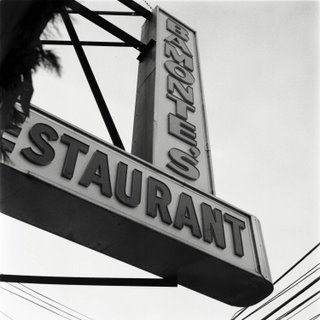
Since 1900, both working class locals and well-heeled epicures have been frequenting Bamonte’s, an iconic Italian bar and restaurant in Williamsburg, Brooklyn. These days celebrity diners include Jack Nicholson and Mike Piazza, but in the 40s and 50s Dem Bums were the ones turning heads in the joint.
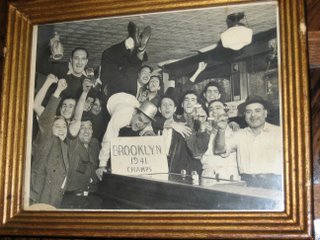
Pee Wee Reese, Carl Furillo, or Duke Snider might stop by to celebrate a big victory with clams casino or get over a tough loss with the famous veal scaloppini. The Brooklyn Sym-Phony Orchestra, five Dodger fanatics who provided a hand-made soundtrack for every game at Ebbets Field, were such regulars Bamonte’s was their unofficial clubhouse.
Lovingly watched over by the ghosts of the boys of summer, Bamonte’s continues to thrive today. Proprietor Anthony Bamonte and his childhood friend and daytime bartender Johnny Pizariello recently took a moment to reminisce about the good old days.
Chris Isenberg: The trolley used to run from Ebbets Field to here?
Anthony Bamonte: It used pass on Lorimer Street.
Johnny Pizzariello: You know that was one of the ways, supposedly, that the Dodgers got their name, people dodging to get out of the way of the trolley. Nobody knows for sure.
 CI:
CI: How many stops to Ebbets Field from here?
AB: I don’t know exactly, 20 minutes, half-hour?
JP: Yeah, the bus on the corner now goes to where Ebbets Field used to be. It’s the same route.
AB: It wasn’t like today, see. The ballplayers were regular guys from what I remember. They had a job plus they played baseball. It wasn’t like today. I mean a lot of these baseball players today are regular also. But in those days it was a working class job. Those fellas couldn’t put two dimes together right, right John?
CI: This neighborhood was mostly Dodgers fans?
AB: Well you had quite a few Yankees fans too. You were either a Dodger fan, a Yank fan, or a Giant fan. But these guys, if you threw a dime down they would fight you for it. Right Johnny? Going back to those days those guys were die-hard fans.
CI: So you would have both factions in here rooting?
AB: Most of the fellas here used to be Dodgers fans.
CI: Did you get to go to any of the World Series games?
AB: No, just regular season. I didn’t go that often. Little Joe-Joe, the midget [who at 92 is the last surviving member of the Brooklyn Sym-Phony], he used to give me one cymbal and he’d hold the other and say, “That’s my partner. He’s coming in with me.”
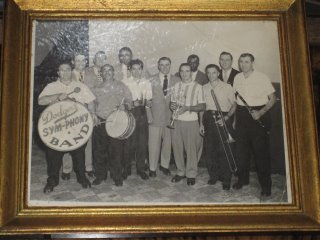
The Sym-Phony. They would play things like “Three Blind Mice” to get on the umpires. When they first started, it was just like a nothing thing, really. Who knew it was gonna be like it is today? They just donated the drum to the Hall of Fame [Cooperstown].
CI: So when Jackie Robinson came up you were seven, do you remember people talking about him at that time in the neighborhood?
AB: One thing I do remember is one time he had to go on the field and there was a threat on his life. Someone was going to shoot him. He went out there anyway. He was a brave man.
CI: How did the neighborhood feel about him breaking the color line? Was the opinion mixed?
AB: I don’t really remember that.
JP: New York wasn’t bad at all. He had trouble in other cities, like St. Louis. New York had a lot of blacks at that time. There was no racial things in New York in the 40s and 50s. That all started in the 60s.
CI: Can you tell me a little about ’55 when the Brooklyn Dodgers won it and how the neighborhood and people in here reacted?
AB: When the team won, at night they would go around in cars and trucks and they would have horns or anything that would make noise. They would hang a dummy that would say Yankees or whoever off of a pole on the truck. They would go through the neighborhood of the Yank fans and they would “give ‘em the business”. Remember the time they used to go around with the dummy on the truck Johnny?
JP: Yeah, they hung the dummies on the lamp posts too.
AB: You don’t see none of that today.
CI: In ’55 did they go nuts in here?
AB: Yeah it was like a big thing for people, from what I could remember. John, what do you remember from on the Northside in ’55?
JP: The tickertape parade on Broadway and in the neighborhoods. It had nothing to do with the city. The people themselves had their own parade.
AB: It was a different era, different type of people, different attitudes. You know what it was in those days? You had that loyalty. Today, I don’t really think there’s loyalty, not compared to what it was in those days.
CI: Who were you closest to out of the ballplayers that came in over the years?
AB: Tommy Lasorda, and then I became friendly with Joe DiMaggio at that time. Joe came here for like seven years.
CI: Can you tell us about DiMaggio?
AB: Joe was a good guy, to me anyways. At the beginning, see, Joe is the kind of guy who waits to see the person you are. Once he sees what kind of person you are, he either likes you or he doesn’t. Anytime he used to come to New York, he used to come here. Joe was a good person. We used to reminisce about the good times.
CI: What did DiMaggio like to eat?
AB: Tomatoes, pasta, ravioli, he used to like the sausages and the peppers. He loved tomatoes. It’s a funny thing he loved tomatoes, and Tommy LaSorda loved tomatoes. I used to get these tomatoes and he used to say, “Anthony where do you get these tomatoes?” And I would tell him Florida, and he would say, “No way, you get these in Florida? No way, I come from Florida and they don’t…” And I used to tease him and say, “Well Joe that’s because they are all up here.” I had to go downstairs one day and I showed him the box. “Joe here’s the box.” Joe would say, “How come they don’t have them in Florida?” I would tell him, “Don’t ask me, ask them in Florida. What am I gonna do, lie to you?”
CI: Do you watch baseball anymore? Do you go to any games?
AB: No, I don’t follow it too much.
CI: How come you aren’t interested anymore?
AB: I was never what you call a real fan, I mean I watched it, but not like Johnny.
JP: When they were playing baseball then there was nothing else. Today, with television there’s a hundred things going on, too many things. Baseball that was it, nothing else was going on.
AB: That’s true.
JP: Football wasn’t big, basketball wasn’t big. Nothing!
AB: That’s why baseball was the American sport, it was like stickball. You played stickball on the street.
CI: When did they first start talking about the Dodgers leaving?
JP: That was 1957. They hated O’Malley, they made dummies of him and they burned them.
AB: We had a flag pole in the yard and the Hall of Fame sent me a letter, they wanted the flag pole. Someone told them that the flag pole came from Ebbets Field, I could have told them it came from Ebbets Field. They wouldn’t know the difference. Someone made them understand that it was from Ebbets Field. As far as I know it came from the American Legion Post, if it was from Ebbets Field, it was news to me.
CI: What did the Dodgers Sym-Phony guys do when they took the Dodgers away?
AB: After they left that was it. Those guys still came in. They were regular guys, nothing special, like me. They were regular working people. They did this as a pleasure, out of loyalty to the Dodgers.
CI: How upset were they when the Dodgers left?
AB: They were all upset.
JP: Everyone was upset.
CI: What do you think it did to Brooklyn and the neighborhood when they left?
AB: It took the sport out of it, you feel like you didn’t have a team to root for.
JP: The expression was, when the Dodgers and Giants moved to California that’s when baseball stopped becoming a sport and it became a business.
AB: It’s all big business today. Look at football, the same way, when the hell did you ever see football being played on turf? Football was always played on dirt from what I could remember, same thing with baseball.
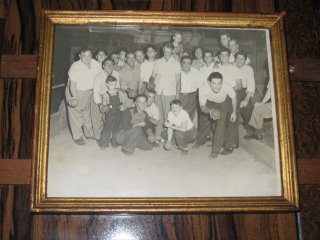
PHOTO CAPTION
Carl Furillo (about to pitch the ball), Joe-Joe the Midget (L of Furillo), and the rest of the fellas playing Bocce Balls in Bamonte’s yard, circa 1941. “They would play for 10 Cents beers. Whoever lost would pay the round.” -Anthony Bamonte
Photo: Matthew Modine
Words: Chris Isenberg and Bud Schmeling
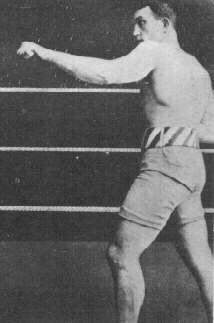
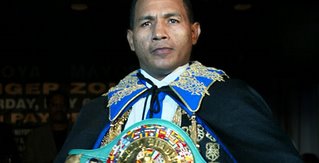 Ricardo Mayorga, ironically nicknamed "El Matador" given his overwhelmingly bullish style, was on my mind this past weekend, both because of the Vernon Forrest match and because Mayorga's September 8th bout with Fernando Vargas is growing ever closer. It's a real shame that this is a PPV fight, because neither fighter is really PPV-caliber right now, and yet this promises to be a rock-em-sock-em robots kind of night that any fight-fan worth his salt will want to see for sure. I've no doubt that you've all seen the video of the Mayorga/Vargas brawl by now, so let me just take you back to a moment from that press conference to set up our Knockout of the Week. Before the fireworks started, Mayorga told the audience that he'd been training for two months already for Vargas and that he plans to be the same fighter that he was when he won his first world title. He then recommended that we all go back and look at the tapes to see just what kind of fighter he was back then.

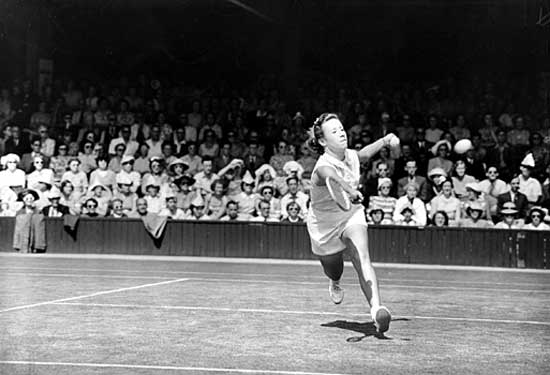 The nickname "Little Mo" was a reference to a famous battleship, the U.S.S. Missouri, known as "Big Mo" - the point was that Connolly, 5'4" and 115 pounds, packed a hell of a punch. I became fascinated with the Maureen Connolly story as a young boy because of a popular TV movie, "Little Mo" that first aired in 1978. It featured some big-time stars in early incarnations - Mark Harmon, Anne Baxter and Leslie Nielson - and Tony Trabert made a cameo appearance as himself. The movie, as did many a TV movie of that period (for some reason it is linked in my mind with a Jan and Dean TV biopic), presented Connolly as a determined and super-talented but also bratty, self-centered adolescent who ultimately is humbled, first by her famous coach (the great Eleanor "Teach" Tennant, played by Michael Learned) and then by fate. I remember that the end of the movie shows a once-embittered Connolly coming on to a court to help a young player who is struggling with her serve, a scene which is evidently not too far from the truth - Connolly went on after the accident to become a great coach herself and guide the career of many a young player at the time.