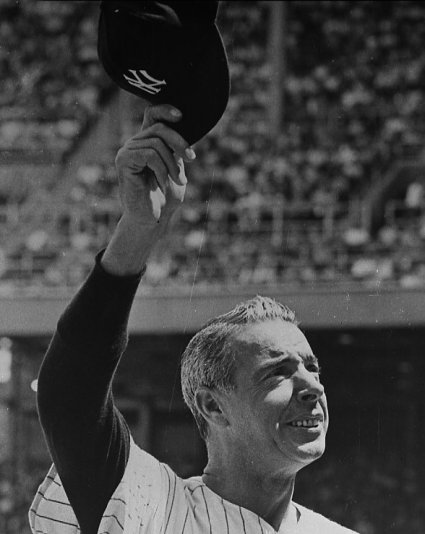
Has the image of any 20th century American icon experienced a more enormous fall from grace than Joe DiMaggio? Talking about this with I-Berg at lunch the other day, the only name that came to mind was JFK, who indeed has seen his name dragged through the mud in the past 20 years, but who also accomplished so much as President that the mere revelation of his womanizing and overall personal ruthlessness did not prove quite enough to entirely tarnish his memory.
I suppose the same could be said for DiMaggio at the purest level - can the tag of "misanthropic cheapskate" ever really put a dent in Joe D.'s epic accomplishments on the diamond? Of course not. Then again, DiMaggio as cultural symbol transcended those accomplishments so thoroughly that his fall - from icon of innate grace and American restraint to parsimonious prick - from "where have you gone Joe DiMaggio?" to "where's my wallet you son of a bitch?" - seems about as dramatic as any that I can think of in the gossip-mad age of the tell-all biography. The plight of the poet Philip Larkin comes to mind - the posthumous publication of his letters brought with it the sad revelation that Larkin was a bitter, racist, misogynist toad much enamored of big boobs and potty humor. Not a winning portrait by any means, but my feeling on this count always has been that if you read Larkin's poetry and couldn't get yourself at least halfway to such a revelation of the man himself, well, you aren't much of a reader.
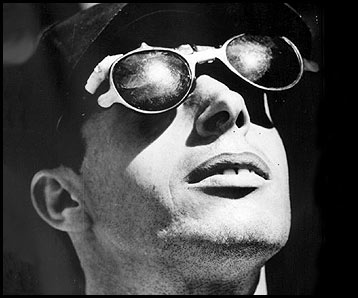
This maybe is what makes the Joe D. revelations so profound - the picture that emerges of him now seems so contrary to the picture that made him the Elegant American Hero in the first place. And let's face it - if the tendency in the post-war era was to create impossibly perfect and elegant heroes, the tendency today is to deflate them with every sharp instrument at our disposal. We don't want fantasies of perfection today - we want to be reassured that our own glaring imperfections are normal and acceptable, and we also want to take great schadenfreudian glee in finding that those who aspire to perfection are in fact the same petty, greedy scoundrels that we know ourselves to be.
So we have pieces like the one in the recent
New Yorker, "The Lost Poems of DiMaggio," a haiku series based on the recent diaries that mock the Clipper's now legendary Scroogery:
Long line of children
Want to have my autograph.That'll be ten bucks.
Cab to the airport
Driver took the long way there
Won't tip that bastard.
Etc. Trust me, the shit is very funny and I laughed out loud. But I felt uneasy as well. I thought of a more famous DiMaggio pop cultural appearance, the episode of
Seinfeld where Kramer sees Joe D. in the coffee shop and tries to distract him from drinking his coffee. Ridiculous as it was, this
Seinfeld treatment still in its way painted a picture of a deeply private and dignified man. If the show were written today, undoubtedly the joke would center on DiMaggio refusing to tip his waitress.
The same issue of
The New Yorker with the DiMaggio haikus includes an article by Louis Menand about the practice of biography writing, an article that I couldn't help but associate with Richard Ben Cramer's mean-spirited bio of Joe D., the true Alamo of the campaign to debunk the DiMaggio myth. In this article, Menand picks apart the self-importance of two recent books, written by biographers, about the task of the biographer. Along the way he points out in his typically terse asides just how dubious the entire concept of "biography" really is, based as it so often is on questionable evidence - letters, second-hand memories, "turning point" theories, diaries - that few of us ever would wish to be judged upon ourselves. In the end, Menand summarizes the biographical impulse, both in production and consumption, in the most cynical of terms, terms that I can't help but think would have earned a solemn nod from The Great Non-Tipper himself:
People enjoy judging other people's lives. They enjoy it excessively. It's not one of the species' more attractive addictions, and, on the whole, it's probably better to indulge it on the life of a person you have never met.
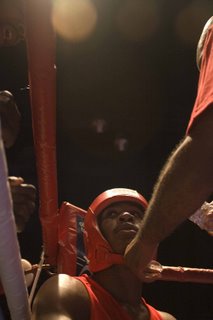 As some of you already know, we have been working on a documentary video project called "Brooklyn to Beijing" about three New York City amateurs trying to make the 2008 US Olympic Boxing Team.
 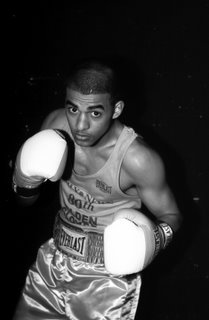 Over the next couple of weeks, you'll also meet Will Rozinsky from Ozone Park and Saddam "World Kid" Ali from Canarsie.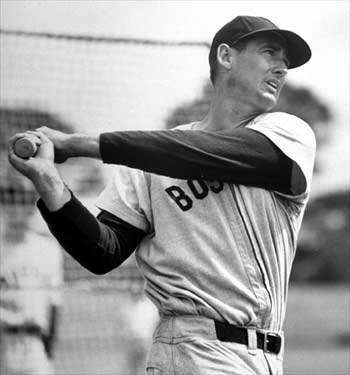




Felix_Trinidad_Photo.jpg)