There was no joy in Brownsville...
for the mighty Curtis Stevens got knocked out.
Words: Chris Isenberg
Photos by: Alex Tehrani (2005)
I went to the Hammerstein last night to see Broadway Boxing in the smaller ballroom upstairs. I wasn't expecting too much. The monthly show exists primarily as a vehicle to develop promoter Lou DiBella’s stable of fighters. Even accounting for the TV rights (it’s taped), DiBella complains that he usually loses money. In the long run, he hopes that one of the fighters he builds up at Broadway and retains under exclusive contract will make it to a big payday. Because today’s boxing marketplace is so unforgiving of even a single loss, it’s unfair to expect highly competitive bouts in the main events—or at least bouts designed to be highly competitive. You go mainly to schmooze with the aficionados, see a local prospect knock out a hand-picked victim, and maybe catch a punchy undercard.
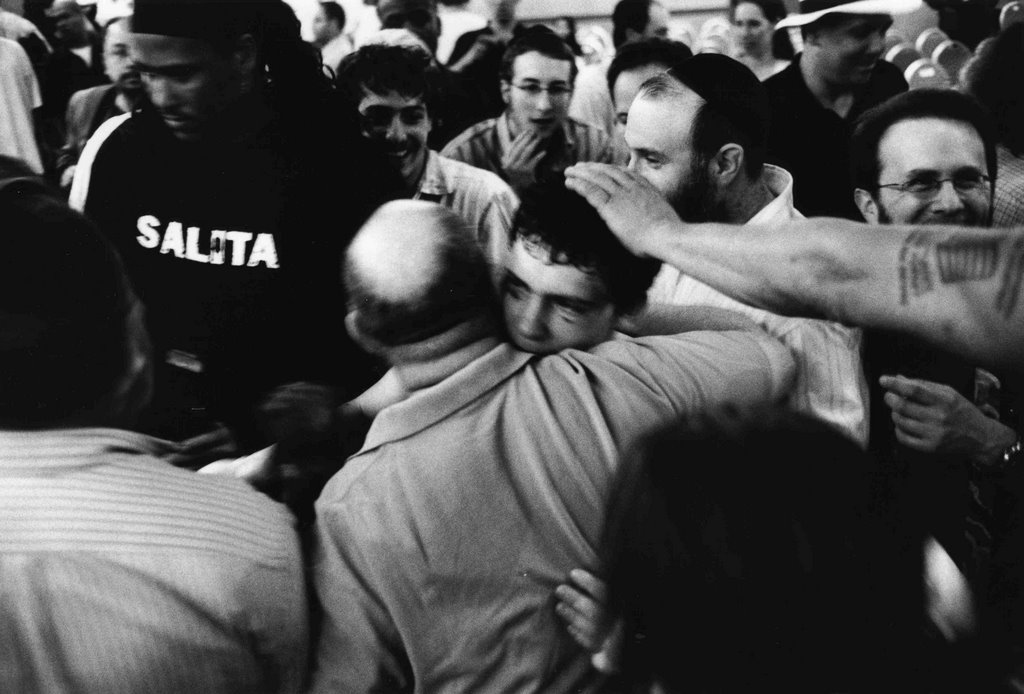
I went to see welterweight Dimitriy “Star of David” Salita (24-0-1 14KOs) and super middleweight Curtis “Showtime” Stevens (13-0 11KOs) put notches on what they both hope will soon be championship belts. The two grew up together at the Starret City Gym in east Brooklyn, where, as has now been chronicled by every wannabe tough Jew writer in New York including me, Salita came in as the only Jewish kid in a very competitive, primarily black program and won acceptance (from Stevens and others) by taking his lumps, learning to slip and move to Hot 97, and staying true to his religion and himself. This week’s New York Magazine features the latest retelling of the Orthodox Jewish Rocky saga, and if Stevens hadn't moved up so many weight classes, he could play Apollo Creed.
In the last year, Stevens has been rapidly catching up to Salita on the hype front. His Brownsville roots, stocky build and knockout pop have led to frequent comparisons to a mini Mike Tyson. He was one of the first fighters signed to Damon Dash and DiBella’s new partnership, and his gangsterfied ring entrance and Brooklyn street cred make him a perfect prospect for a hip-hop boxing crossover.
The first surprise of the night was that Dimitriy’s originally scheduled opponent, James Wayka of Mounds View, MN., (14-4, 8 KOs), was a scratch. The word was that he had been arrested on some kind of alimony beef and never made it out of Minnesota (which seemed a little fishy since it would probably have made more sense to get him after the payday). It was then announced that the emergency replacement opponent, Shad “Crazy Train” Howard of Russellville, MO (12-7-3 6KOs) had missed the morning flight and was still in the air.
These mishaps led to an unusual amount of stalling between the preliminary bouts, which led to an unusual amount of socializing in the clubby ballroom upstairs at the Hammerstein. The Broadway crowd is always a racial ragu, especially when a black and a Jewish fighter share top billing. With Dimitriy drawing heavy with beard-and-yarmulke Lubavitch and Curtis Stevens with bandana and flat-brim Brownsville, the room had all the ingredients to make Crown Heights II, but somehow ended up feeling more like an interracial remake of Cheers.
In the row behind me, a black guy listened politely while a jowly Jewish dude held forth on the problems in the Middle East: “The Jewish Liberation was only two days old when every Arab country attacked them. Syria, Egypt, Jordan…every one.” By the time Stevens came into the ring at eleven, he was halfway through the Yom Kippur War.
Stevens’ ring entrance is half the fun of seeing him fight. He walked out of the dressing room wearing sequined turquoise shorts and a bandana over his entire face (including his eyes), and when he arrived at the center of the ring, he bent at the waist and swung his clenched fists back and forth just above the canvas in imitation of a gorilla. Finally he unmasked himself, stared down his opponent and sliced his hand across his own throat in a bold gesture that promised swift execution.
Marcos Primera, a 19-15-2 journeyman from Puerto Cabello, Venezuela seemed unmoved. Primera looked to be in his late thirties and he did not have sequined shorts, tattoos, a nickname, or Irv and Chris Gotti cheering for him at ringside. But he did have thirty six fights behind him, and as it turned out, a plan.
The plan unfolded slowly, and Curtis Stevens wasn’t the only one fooled.
For the first few rounds of a scheduled eight, Primera barely threw a punch. He stood almost fully sideways and absorbed heavy hooks and uppercuts from the shorter Stevens. Instead of shaking his head no after a clean shot landed to convince everyone that it didn’t really hurt, Cabrera had the unusual habit of shaking his head yes and making an expression which seemed to say: “Oh, Mr. Stevens your punches are so very hard. How will I possibly withstand them?” This affirmative head-shaking should have been a tip-off that Cabrera was playing possum, but especially after a cut opened up under his right eye in the third, his act was very convincing. He truly looked pathetic.
By the fifth, the one-sidedness of the fight and length of time I had waited to see it were combining to make me feel morbid. I had wasted my night to see another bum sacrificed to Curtis Stevens and it wasn’t even going to be a knockout. I floated a discontented theory to my gray-haired neighbor, whose name I didn't get but who I've seen before working corners.
“Guess he just wanted the free trip up from Venezuela,” I said.
“No,” he cautioned. “If he wanted to flop he could have done it on half a dozen of those punches. He’s got almost forty fights. He’ll do something.”
In the sixth, Stevens, who must have felt like he was fighting a turtle, started to tire, and towards the end of the round, Primera suddenly opened up and punched with both hands, landing long straight jabs and crosses. A dozen self-appointed coaches yelled advice to Stevens.
“Come on Curt, He got a bullseye right on his eye.”
“Give him a Danny Jacobs, Curt.”
“Overhand right when you slip the jab.”
“Tyson, Curt. Tyson!”
In the middle of the seventh, Primera trapped Stevens in his own corner and began landing his clean, damaging shots. Stevens suddenly looked very small. He dipped low at the knees as if he might buckle and then fired an uppercut directly into Primera’s cup. It was difficult to tell if Stevens had slipped or if he had struck out of desperation, but either way it was a brutal low blow. Cabrera flopped to the canvas in pain, and then crawled on all fours back to his corner. Brownsville found it a little too dramatic.
“Yo, stop fakin!”
For a moment it seemed like there might be an immediate disqualification, but after consulting with commissioner Ron Scott Stevens at ringside, the referee gave Primera five minutes to recover. If he had been unable to continue at that point, the fight would have gone to the cards, and Stevens would have easily won a unanimous decision. But at the end of the injury time, Primera signaled that he was ready to go on.
In the eighth, both fighters' cards were on the table. Primera had saved up his resources for one more big round. Stevens was frustrated and tired, but all he needed to do was stay on his feet.
I didn’t actually see the punch that did Curtis Stevens in, even though I had the perfect angle. I don’t think anyone saw it well, certainly not Stevens. A few of the online beat writers huddled after the fight to make sure they had their facts straight. Consensus was that it was a right uppercut on the chin.
Stevens wobbled and Primera half-pushed him to the canvas and the referee called a knockdown. Stevens should have taken a knee and waited eight or nine seconds to clear his head, but there is no mandatory eight count in New York State. Instead he sprang up right away, and Primera moved in for the kill.
“Curt, tie him up!” "Grab him, Curt!” the self appointed coaches screamed.
Stevens did not or could not do this. Primera trapped him on the ropes again and began lining up and landing short punches to the head. Stevens didn’t move to block or counter, and the referee jumped in between the fighters and waved his hands. It was a good stoppage. Stevens was out on his feet and defenseless.
Brownsville was stunned.
“Get ready to duck,” my neighbor said.
Primera didn’t have anyone to celebrate with (not even his own corner seemed very happy), but still jumped in the air and pumped his fist. The crowd groaned. Someone threw a beer. Someone else threw popcorn. A kid with a flat brim Mets cap jumped into the ring. Security guys in their black suits rushed in awkwardly, but weren't needed.
A young girl wearing skintight jeans and sequined white shirt began crying.
“He cheated!”
She pulled out a cell phone and punched in a number. She could barely get the words out as the tears streamed down her face.
“They cheated my cousin. They cheated my cousin.”
More cell phones came out. More calls were made. And in a few moments, everyone back in Brownsville knew that Curtis Stevens wasn’t undefeated anymore.
Dimitriy Salita looked slow and very hittable again, but managed a sixth round TKO over "Crazy Train" Howard, who may have wished he had missed the evening flight as well. Despite the victory, Dimitriy's fans were pretty quiet. Even though it wasn't their own man that fell, they had seen what it might be like to call home to Brooklyn with bad news.
1 Comments:
The first line in the FADER article had me cracking up, the bit about the talking dolphin. And I didn't realize that there was all this sanctioned boxing in rural Missouri, I'd never even heard of Howard, people only talk about Corey Spinks in StL. Once I saw a mixed martial arts card in the back of a bar in Columbia, MO, and somehow they packed in a thousand for a great show.
Post a Comment
<< Home