Borne back ceaselessly into the past
 On this day in 1925, one of the most celebrated and influential novels of the twentieth century was officially released to the public. F. Scott Fitzgerald's The Great Gatsby met with little or no fanfare in its earliest incarnation, and though admired by other writers, it was never a tremendously popular book during Fitzgerald's lifetime. Only as the decades wore on did it slowly ascend to the place it now occupies in American literature, as the definitive novel of the Jazz Age, as a Keatsian tragedy of ambition and loss, and as maybe the one true near-perfect Great American Novel.
Sports occupies only a small part in the book's cosmology, but not an inconsequential one, and one that takes us back to a different era of the socio-cultural implications of sport and, as it might have been called at the time, "leisure." In this quintessential novel of class envy, Tom Buchanan, husband of Daisy (Gatsby's obsession), is the true man of leisure, a fact connoted not only by his massive, inherited wealth, but by his stature as a once-famous college athlete.
Introducing Tom, the narrator Nick Carraway says:
"Her husband, among various physical accomplishments, had been one of the most powerful ends that ever played football at New Haven—a national figure in a way, one of those men who reach such an acute limited excellence at twenty-one that everything afterward savors of anti-climax."
An air of brutality hovers around Tom through the entire novel. Later, Nick comes upon Tom in the ultimate pose of the aristocrat sportsman, swathed in the "effeminate swank of his riding clothes," a sturdy, powerful lion of a man. "... He seemed to fill those glistening boots until he strained the top lacing, and you could see a great pack of muscle shifting when his shoulder moved under his thin coat. It was a body capable of enormous leverage—a cruel body."
The athlete in Fitzgerald's day, particularly the football player, was a privileged sort - one with the free time for such pursuits, one with an Ivy League pedigree and All-American swarthiness. More than his wealth, Tom Buchanan's Yale-ian football credentials in many ways symbolize everything that Gatsby can never achieve nor offer to Daisy no matter how much money he amasses in the bootlegging business. Tom walks with the knowledge of his social standing and achievement, with confidence, virility, and the seeming favor of the gods in everything he touches. Gatsby tries desperately to create this myth of himself to go with his ill-gotten fortune, and turns to sport in the dissimulation, showing Nick a fabricated picture of him in cricket whites, supposedly taken at Oxford. It's the essence of Gatsby's tragedy as seen through the eyes of Nick that he spent his life trying to remake himself in the image of the Tom Buchanans of the world, men so affluent and accomplished and so entirely hollow in their souls. In this way, the book is basically a Roaring 20's morality play of jocks and nerds, or in the more historical way of putting it, the haves and the have-nots. As it so often does, sports proved a crucial signifier in the terms of the divide.
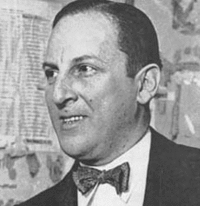 One final note - sports also winds its way into the Gatsby universe in the character of Meyer Wolfsheim (great name). Nick meets Wolfsheim at Gatsby's one afternoon and Nick immediately recognizes him as an infamous gambler. Due to this meeting, Nick begins to suspect that Gatsby is not all that he has made himself out to be. Wolfsheim shows off his cufflinks to Nick, which he claims are made of human molars, and he also boasts openly of having fixed the 1919 World Series. He is, of course, a caricature of Arnold Rothstein, the gambler and criminal who is considered responsible for the Black Sox Scandal, and who later died in rather spectacular fashion. One wonders if Rothstein actually did wear cufflinks made from molars. I prefer to think not.
posted by Large at 1:11 PM


1 Comments:
Man, that Rothstein was crafty..
Post a Comment
<< Home