Luna vs. Chavez
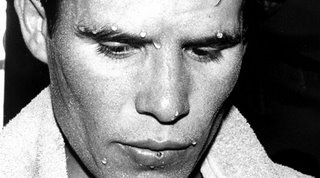 Going into the premiere last night, I felt I had a lot of good reasons to be skeptical about "Chavez", the feature doc directed by actor Diego Luna, the third side of the Y tu mamá también triangle. If my chief objection was rooted in envy, the crowd at the Clearview on twenty-third and ninth only added fuel to the player hating fire. As my movie-going compadre Bud Schmeling put it, “There was the whiff of Andalusian beauty in the air.” Okay probably the majority of the raven-haired throngs were from Mexico City, but that sounded better. And from the eager looks on their high-cheeked faces when a high-spirited Luna, all grown up in a sharp blue suit, came down to the front of the room to introduce his film, you got the strong feeling that his on screen adventures with Ana Lopez Mercado might actually pale in comparison to his real life.
  If that wasn’t enough to get your hackles up, there was the more legitimate concern: how did this kid have the stones to try to tell the life story of Julio Cesar Chavez. Basically we are talking about the rough equivalent of a young Matthew Broderick deciding Ferris Bueller’s Day Off qualified him to direct the Muhammad Ali story. Luna is not an accomplished filmmaker (this was his first), he’s not any kind of boxing authority, and according to his father, who Bud got talking to at the after party at the Maritime, he hadn’t even been a huge Chavez fan growing up. For all these reasons, “Chavez” had all the ingredients to be the worst kind of exercise in celebrity dilettanteism--which would have been especially hard to stomach since Chavez’s story is so worthy of a good telling. In short, I had my doubts.
They weren’t all erased, but “Chavez” still won me over. There were stretches, especially a slow bit in the middle about Chavez’s relationship to Carlos Salinas and Mexican politics, where it seemed Luna had bit off more than he could chew, but they were more than balanced by some sublime revelations about boxing and about fathers and sons.
The centerpiece of the film is the September 2005 fight against Grover Wiley, which was not supposed to Chavez's last. As Bob Arum tells it, he had dubbed the promotion “Adios Phoenix” and it was designed to be part of a larger “Adios” tour which started with “Adios Los Angeles” hit “Adios Texas” and “Adios Atlantic City” and then extended indefinitely towards “Adios, Adios”.
By this point in the farewell tour, Luna has managed to gain Chavez and his son’s confidence and is given complete and total access as both Chavez Sr. and Jr. prepare to fight on a card that was built to give the two of them easy wins and send the Mexican-American population of Phoenix home happy. Things do not go according to plan, and this is where Luna finds his film.
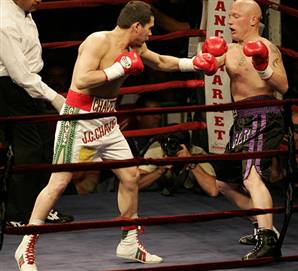 I won't go too far and spoil it, but the part already long on record is that Chavez’s corner threw in the towel between the fifth and sixth round. It was an utterly humiliating way for one of the hardest men in the history of the hardest game to go out. But the rough poetry of boxing is wrapped up in the fact that no one seems to get to say Adios on their own terms: not Joe Louis, not Ali, and not Julio Cesar Chavez. The best storytelling about boxing—the reportage of Gay Talese and A.J. Liebling, W.C. Heinz’s “The Professional”, Scorcese’s Raging Bull--finds the beauty in those most terrible moments of failure and finality.
In the aftermath of “Adios Phoenix”, on the long trip back down the corridor and in the dressing room, there is no doubt that Diego Luna caught some moments that can stand in this canon. The mean-spirited may say he just got lucky. Fairer judges will know that whatever advantages his celebrity gave him, he made his own luck. It's not easy for anyone to get the kind of access he did, or to know how to treat the fruit of that access. Luna caught something incredible and he knew both how to make the most of it and how to treat it with respect. For that, he earns our sincere congratulations and our recommendation. You should see Chavez.


1 Comments:
Even though I've got a hunch you've read it, your post spurred me to a recommendation: Norman Mailer's "The Fight". One of the best examples of boxing (indeed, sports) writing ever produced.
Post a Comment
<< Home