There Was Nothing Wrong with That Goolagong
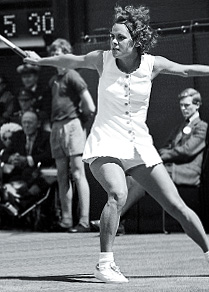 Some strange news from the world of tennis today, as the WTA announced that it would award the number one ranking to Evonne Goolagong Cawley retrospectively for a two-week period in 1976.
This came about due to the recovery some lost records that indicated that Goolagong had overtaken Chris Evert for a fortnight in that long-passed bicentennial summer.
This bit of news brought two thoughts to my mind. The first was... who in the hell is sitting around some godforsaken office somewhere looking for these lost files of the WTA from 1976? Is this a mystery they've been trying to solve for years now? JESUS. I guess you have to admire them in a way. Myself, I have to imagine I might have given up by now on the whole "those mysterious two weeks in the summer of '76" controversy.
After I pondered that, however, I turned to a more pleasant second thought, which of course was of the righteous Miss Goolagong in her prime. I was fascinated with her as a child tennis fan, first and foremost because she had the greatest tennis name that ever there has been. And then she had a countenance that was entirely worthy of her Goolagong-ness - she played with laconic grace, her skin was bronze and her legs eternal, and she always had a mysteriously detached air about her on the court, as if she were there and yet not really there at all. Yet she played ferociously in big moments, despite frequently, as Bud Collins used to put it, going on "walkabout" in her matches.
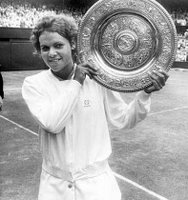 It was only later that I realized the implications of this characterization of Goolagong, implications that perhaps do not reflect all that well on crazy ole Bud. Only later, too, did I realize that I was witnessing real history as I watched her in the 70's, because I was watching the Althea Gibson of Down Under, the first Australian aboriginal to win a Grand Slam title and the first to achieve worldwide fame as an athlete. Throughout her climb to the top, she battled racism of the kind that would be all too familiar to African Americans in the States, and was only permitted onto a tennis court in the first place because a white local noticed her peering through the fence at a world and a sport from which she was excluded at the time due to her aboriginal status.
She won seven women's Grand Slam singles crowns, and was a Grand Slam runner-up an amazing 11 times. Behind Margaret Court, Billie Jean and Chrissie, she was the fourth best women's player of the 70's in maybe the most competitive decade the women's game has ever known. But more importantly, she became an icon of liberation and equality for all Australian indigenous people, a fact underscored by the reverence which she has enjoyed there for decades now. For evidence of that, just check out the video below and ask yourself if you've ever heard a song about Chris Evert.
posted by Large at 11:52 AM


1 Comments:
is a shame that she's not really celebrated in an appropriate manner down here, she certainly walked the hard road..
Post a Comment
<< Home