One more shopping day left...
NO MAS BOOK REVIEW
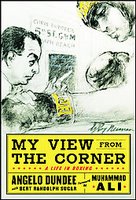
My View from the Corner: A Life in Boxing (2007)
Angelo Dundee with Bert Sugar
McGraw-Hill, 337 p.
Anyone even remotely connected to the boxing universe knows that Angelo Dundee is one of the nicest guys, if not THE nicest guy, in the business. I met him on the set of Classic Now and approached him meekly just to shake his hand and profess my admiration for his work. He jovially complimented me on my Everlast hoodie and then engaged me in conversation. When I mentioned that I'd recently watched the Clay/Doug Jones fight, he started telling me everything he remembered about the fight, and was about to start in on Leonard/Hearns when his segment was ready to tape. After that, whenever he was on the show I would talk to him, and though he never remembered who I was (and why would he?), he always was as eager to shoot the shit with me as he was the last time we'd met. Once I got his autograph in one of my boxing books, and he signed it, "Dear Dave, thanks for asking," as if the honor was all his.
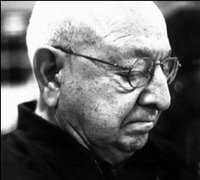 Even Dundee himself alludes to his legendary niceness in his new memoir, My View From the Corner, mentioning that it was once said of him that if someone started badmouthing Charles Manson in his presence, he probably would say "ah, I don't know, he had some good traits."
What I'm trying to get at here is that I'm conflicted about reviewing Dundee's book, or more, conflicted about badmouthing a book written by a man who wouldn't badmouth Charles Manson.
So I'll guess start with the good stuff. The first 50 pages or so are engrossing, telling the story of Dundee's rise through the trainer's spit-bucket education on the coat-tails of his semi-bigtime promoter of a brother, Chris. Here we get a taste of what feels like the unadulterated reminiscences of Angie, written in a lively prose that genuinely captures the cadences of Dundee's unique speech patterns. These chapters paint an insider's picture of a bygone universe that fascinates me, one that I admit I am inclined to heavily romanticize - Stillman's, the old Garden, Toots Shor's, Blinky Palermo and Frankie Carbo, Whitey Bimstein, Chickie Ferrara, Charlie Goldman. Unquestionably for me, the most compelling passages of the entire book are Dundee's memories of sitting around a table at the Natural or the Garden Cafeteria as a trainer's apprentice listening to the giants of his trade swap stories about their fighters. I could have done with about a hundred more pages of that business.
Sadly, the entry of young Cassius Clay onto the scene (and the disappearance of Willie Pastrano) signals the beginning of the end of the good stuff, a problem that is only partially Dundee's fault. For the story of Clay/Ali is such heavily trod territory to a boxing fan today that once the book turns into a sequential recitation of The Ali Journey, it loses most of its originality and starts to seem like a halfass SportsCentury. Dundee's voice gets obscured as well by that of his ghost-writer Bert Sugar, a problem that plagued the book for me after the opening chapters, as what previously felt like a folksy and intimate conversation with Dundee turns into a Bert Sugar-styled history lesson written in the first person of another man.
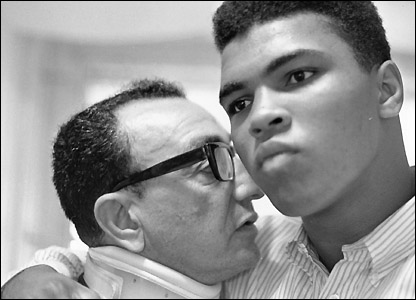 This maybe would be forgivable if Dundee's memories added much to the familiar tale that we didn't already know, but there's precious little of that here. Angelo slicing and then removing Clay's "damaged" glove in the Henry Cooper fight to buy his injured fighter some time? Clay's blood pressure going through the roof as he did his crazy routine at the Liston press conference? Angelo shouting down Bundini Brown in Ali's corner to stop the humiliation of the Larry Holmes fight? Take these three anecdotes above as indication of how interesting this book might be to you. If you've never heard these stories before, they are well told here and this thing is probably worth your while. If you have heard them, however, heard them maybe a hundred times, then you're not missing much by taking a pass on My View from the Corner.
After the Trevor Berbick debacle and some kind, banal words on the spirit of Ali, Dundee moves on to his time with Sugar Ray Leonard, a gig that he was less enamored of for sure than his tenure with The Greatest. In fact, in these memories Dundee finds a man evidently more odious than Charles Manson himself, because he goes out of his way to heap scorn upon Leonard's ironically named lawyer, Mike Trainer. Nevertheless, insight-wise, the Sugar Ray chapters are about as bland as the Ali material. In other words, if "you're blowing it son!" is a line that means nothing to you, you're going to hear a few stories you've never heard before, but otherwise you'll be on very familiar ground.
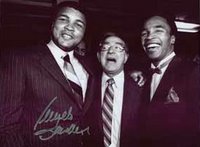 The book finishes with a cursory treatment of Dundee's stint with George Foreman in the 90's, and here I confess I did learn something new - that Angelo started working with Big George only after George disposed of one of Angie's fighters, the long-lost heavyweight contender Adilson Rodrigues. The Foreman stories are a punchy way to end the book and take the story out on a high note, but the brief wrap-up final chapter left a bad taste in my mouth largely because of an anecdote that I have to believe an editor might have caught and taken out of there. In writing of the boxing death of Davey Moore in 1963 (yes, that Davey Moore, the subject of Dylan's boxing protest number, "Who killed Davey Moore why and what's the reason for?"), Dundee claims that it's a double tragedy in his memory, because not only was it his fighter Sugar Ramos who beat Moore to death that night, but also because another one of his fighters, Luis Rodriguez, won a great victory on the undercard that was completely overshadowed by Moore's death. This callous assessment of the situation doesn't sound anything like Angelo Dundee to me, and I can only imagine it's some twisted translation of what actually came out of his mouth on the topic. I hope it gets scratched from future editions.
Otherwise, look, to tell it in Angelo-ese, it is what it is - 50 pages on the good old days, 170 on Ali, about 50 more on Ray Leonard, 30 on Big George and a coda to close it out. Myself, I wanted a lot more insight into the nitty-gritty details of a trainer's profession, and hell of a lot more anecdotes about Dundee's other well-known charges, fighters like Pastrano, who gets short shrift at best, and Carmen Basilio, an all-time great and fascinating figure who inexplicably gets the shaft, about a page and a half total mention.
But hey, we all know it's names like Ali and Sugar Ray that move units, and even given my qualms, as a last-minute gift for the boxing fan on your list, you definitely could do a lot worse than this.
posted by Large at 6:30 PM


3 Comments:
Large,
Have you ever done a "Best Boxing Books" post? I'd be interested in what you recommend.
I just read "The Last Great Fight" and, after watching Tyson/Douglas again, I pretty much think Buster Douglas was operating ON THAT ONE NIGHT at close to the greatest heavyweights who have stepped in the ring.
I mean, dude was only an inch shorter than Lennox Lewis, with the same reach.
Tommy - never done the best boxing books, but it would be a good topic no doubt. I'd have to put a lot of work into that one because it's a topic I care about passionately.
I was just getting around to "The Last Great Fight", much as I loathe and disagree with the title. How was it?
I'm interested in your take on Buster, although I can't say I agree. He had a great night no doubt, but I've always thought that Tyson was there for the taking for anyone with a stiff left and mobile and artful enough to get through five unscathed. In my mind, Larry Holmes in his prime would have killed Tyson in his prime, and that edition of Tyson that Buster fought was a much diluted spirit if you know what I'm saying.
But hey, you've just read that book so you probably have some interesting insights. Maybe we should have an exchange after I read it.
It's definitely worth the read. I was afraid that it wouldn't have much information I didn't already know, but it's obvious the author did a lot of research. He glosses over almost all of the things that the "Legendary Nights" show covered, which was good.
The thing about Buster is, he is a) huge (6-5, lean 240) and b) a great athlete (good basketball player). He's got a great jab and real power in his right hand (witness the final uppercut he lands on Tyson). Unfortunately, he didnt really have the temperament for boxing (the book details a couple of fights he quit in, including Tony Tucker, who he was beating) or get himself in great shape. For this fight, for whatever reason, he got himself in amazing shape, was determined, and given a final edge by his mother passing away three weeks before. His weaknesses became strenghts for that night, and in combination with his considerable physical gifts it's a pretty awesome combo. Eight months later, he was worse than ever and quit again against Evander.
I just picked up "Cut Time", which is by an professor/boxing observer. Looks interesting
Post a Comment
<< Home