Deep Tennis with Steve Tignor
Steve - the discussion of the greatest men's tennis player of all time has boiled down to one titanic match-up that fascinates everyone - Sampras v. Federer. To me, this unfairly throws Laver on the dustbin of history, left out of the conversation because of the evolution of the game and the passage of time. So my question is - first of all, is there anyone else you think is getting short shrift from the prevalence of the Sampras/Federer conversation, and then how are we to measure Laver and the other greats of the past against Pete and Fed when the game has changed so much?
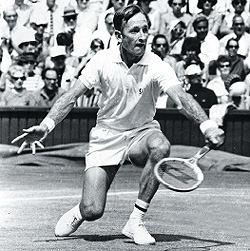 I’ve thought of doing an article about how Laver has been dropped from tennis’ GOAT (Greatest of All Time) discussion. I wouldn’t say it’s unfair, exactly—if you see any old clips of the 5-foot-8 Aussie flicking the ball around with his tiny-headed wood racquet, you could only conclude that he would have been, well, mauled by the 6-foot-1 Pete Sampras and Roger Federer.
Look a little closer, though, and you can begin to appreciate why Laver still has a place in the debate. I think of him as the master of “small ball tennis,” or “dead-ball era” tennis (maybe “dead-racquet-era” tennis is the best way to say it). This was a time when being able to hit every shot in the book was as important as being able to hit them hard. (The book of essential tennis shots and skills has gotten much thinner since Laver’s day—pretty much the entire net game has been abridged.) Laver had them all, from the hook lefty serve out wide to the one-handed topspin backhand pass up the line to a deadly slice lob that has all but disappeared from the game. He did all the things you’re taught to do as a kid, but which the pros don’t bother with now—change speeds, sneak into the net, construct points.
Laver does share two things with Federer and Sampras: (1) He was a shy man and a gentleman, the opposite of what we’re told top professional athletes need to be to succeed. (2) Laver, Federer, and Sampras were all the Sandy Koufaxes of their eras. By that I mean they started out as throwers, guys with so much raw skill they didn’t know what to do with it. It took them longer than some other top players to learn to be pitchers, to get all that talent under control. None of them won Grand Slams out of the gate, but once they mastered their own games, they were utterly dominant.
Laver did it by adhering to the simple but strict practice sessions mapped out by his Davis Cup coach, Harry Hopman. They were always two hours on the nose, always involved a half-hour of forehands crosscourt, a half-hour of backhands down the line, etc., and always finished with a half-hour of match play. One journeyman player spent a week practicing with Laver and found himself playing the best tennis of his life—he said the difference was the way Laver made every shot count. He ended up thinking, “If only I’d practiced like that my whole life, I think I could have been No. 1…”
The other legendary figure who was once a regular in the GOAT discussions, but who’s largely forgotten now, is Lew Hoad. An Aussie champ from a slightly earlier era than Laver’s, he’s long been considered the best athlete the sport has seen—the purest tennis player imaginable. Watching a few clips of him, at first I wondered what the fuss was about. He hit a nice kick serve, but he also hit an old-fashioned flat forehand like everyone else from that era. A few games in, though, Hoad rushed the net and his opponent threw up a lob. He launched himself backward off one foot and, with no wasted motion, snapped the ball away with a crisply efficient overhead and immediately headed back for the next point. All I could think of was Sampras—the resemblance, as well as the natural athleticism, was uncanny.
This is a long way of saying that at the level of wins and losses, there’s no way to compare eras in tennis, or at least there’s no way of comparing the amateur-wood era with the pro-graphite era. (Andre Agassi and Jimmy Connors began late enough that they were able to cross multiple modern eras and succeed in all of them.) The only resemblances between now and the pre-Open era are found in those fleeting glimpses of past greats like Hoad, which remind you that tennis genius is eternal.
As for Laver, if you can’t call him the GOAT, at least you can say this: He was the best at what he did.
Steve Tignor is the executive editor of Tennis magazine. For more of his writing, check out his weekly column, The Wrap, on the Tennis website - today he takes on the match on everyone's mind, Guillermo Canas's upset of Moby Fed in Key Biscayne.
I’ve thought of doing an article about how Laver has been dropped from tennis’ GOAT (Greatest of All Time) discussion. I wouldn’t say it’s unfair, exactly—if you see any old clips of the 5-foot-8 Aussie flicking the ball around with his tiny-headed wood racquet, you could only conclude that he would have been, well, mauled by the 6-foot-1 Pete Sampras and Roger Federer.Look a little closer, though, and you can begin to appreciate why Laver still has a place in the debate. I think of him as the master of “small ball tennis,” or “dead-ball era” tennis (maybe “dead-racquet-era” tennis is the best way to say it). This was a time when being able to hit every shot in the book was as important as being able to hit them hard. (The book of essential tennis shots and skills has gotten much thinner since Laver’s day—pretty much the entire net game has been abridged.) Laver had them all, from the hook lefty serve out wide to the one-handed topspin backhand pass up the line to a deadly slice lob that has all but disappeared from the game. He did all the things you’re taught to do as a kid, but which the pros don’t bother with now—change speeds, sneak into the net, construct points.
Laver does share two things with Federer and Sampras: (1) He was a shy man and a gentleman, the opposite of what we’re told top professional athletes need to be to succeed. (2) Laver, Federer, and Sampras were all the Sandy Koufaxes of their eras. By that I mean they started out as throwers, guys with so much raw skill they didn’t know what to do with it. It took them longer than some other top players to learn to be pitchers, to get all that talent under control. None of them won Grand Slams out of the gate, but once they mastered their own games, they were utterly dominant.
Laver did it by adhering to the simple but strict practice sessions mapped out by his Davis Cup coach, Harry Hopman. They were always two hours on the nose, always involved a half-hour of forehands crosscourt, a half-hour of backhands down the line, etc., and always finished with a half-hour of match play. One journeyman player spent a week practicing with Laver and found himself playing the best tennis of his life—he said the difference was the way Laver made every shot count. He ended up thinking, “If only I’d practiced like that my whole life, I think I could have been No. 1…”
The other legendary figure who was once a regular in the GOAT discussions, but who’s largely forgotten now, is Lew Hoad. An Aussie champ from a slightly earlier era than Laver’s, he’s long been considered the best athlete the sport has seen—the purest tennis player imaginable. Watching a few clips of him, at first I wondered what the fuss was about. He hit a nice kick serve, but he also hit an old-fashioned flat forehand like everyone else from that era. A few games in, though, Hoad rushed the net and his opponent threw up a lob. He launched himself backward off one foot and, with no wasted motion, snapped the ball away with a crisply efficient overhead and immediately headed back for the next point. All I could think of was Sampras—the resemblance, as well as the natural athleticism, was uncanny.
This is a long way of saying that at the level of wins and losses, there’s no way to compare eras in tennis, or at least there’s no way of comparing the amateur-wood era with the pro-graphite era. (Andre Agassi and Jimmy Connors began late enough that they were able to cross multiple modern eras and succeed in all of them.) The only resemblances between now and the pre-Open era are found in those fleeting glimpses of past greats like Hoad, which remind you that tennis genius is eternal.
As for Laver, if you can’t call him the GOAT, at least you can say this: He was the best at what he did.
Steve Tignor is the executive editor of Tennis magazine. For more of his writing, check out his weekly column, The Wrap, on the Tennis website - today he takes on the match on everyone's mind, Guillermo Canas's upset of Moby Fed in Key Biscayne.
2 Comments:
The best players for me have always been the brats, Goran Ivanisevic is the GOAT, followed by Marcelo Rios and Marat Safin.
Mostly flawed players who make you root for them. I just hate polished guys like Sampras and federer. Although the qarter final between Corretja and sampras at the US open a few years ago was the best tennis match i've ever seen.
rod laver has his own shoe for the past million years.
respect due.
Post a Comment
<< Home