Sentimental Education
On this day in 1995, Mike Tyson was released from prison in Indiana after serving a three-year sentence for the rape of Desiree Washington in 1991.
Recently, I re-read a Pete Hamill article written for Esquire during Tyson's prison stay. Titled "The Education of Mike Tyson, " the piece documents a trip Hamill made to visit Iron Mike at the Indiana Youth Center in 1994. In retrospect, it's chilling reading, particularly in view of what has become of Tyson in the past few years - champion turned savage turned tabloid clown.
The picture Hamill paints of Mike in prison is that of a hungry-minded man who has woken from a nightmare and begun to reckon with the true essence of himself. Haunted by the spectre of his lost surrogate father, Cus D'Amato, Mike heeds the old trainer's words about the mind being just another muscle, and in confinement discovers that muscle's application. In the course of his discussion with Hamill, Tyson alludes to his reading list frequently, not as a man eager to show off his accomplishments, but as a wide-eyed student wrestling with a maelstrom of new ideas. Among his references are George Jackson's Soledad Brother, a history of the Haitian revolution, The Great Gatsby, Machiavelli, Candide, The Count of Monte Cristo ("I identify... with Edmond Dantes in the Chateau d'If. He was unjustly imprisoned too"), Hemingway, Francis Bacon, Tolstoy, biographies of Mao, Ghengis Khan and Cortez, Maya Angelou, Arthur Ashe's Days of Grace, and of course, the Koran.
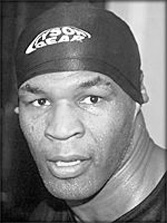 This is a side of Tyson that rarely has been reported upon, the solitary searcher with a much more active and able brain than America ever wanted to believe of its feral, ghetto-born warrior. Mike converted to Islam in prison and for at least the duration of his sentence seemed affected by its tenets, discovering a potential for humility and discipline in himself that led to him look back on the excesses of his life outside with wonder and disgust. "It was all unreal," he says. "Want to go to Paris? Want to fly to Russia?... Let me have two of those and three of them and five of those. Nobody knows what it's like - fame, millions - unless they went through it... I had a thousand women, the best champagne, the fanciest hotels, the greatest meals - and it got me here."
He tells Hamill that when he gets out of prison he wants to go to college, that he wants to go back to Paris so he can visit the Louvre, that what he misses most about his life is bullshitting with his friends and flying his pigeons and talking to Camille Ewald (Cus's companion). All in all, he sounds like a crack addict who has gotten clean and is dizzy at the prospect of a different, more rewarding existence. "The pink cloud," they call it in recovery, the beginning of the journey to freedom.
Looking back, it's heartbreaking to know how soon after his release Tyson was puffing again on the vainglorious pipe, how soon college and the Louvre and the pigeons were sacrificed to the gods of hubris and chaos. Maybe the most ironic and saddest thing there is to say about Mike Tyson is that in all his misguided lifetime there was only one brief period when rays of sunshine dawned on his mind and he experienced intimations of what it might feel like to be a free man. And those were the years he spent in jail.
(Pete Hamill's Esquire article isn't available anywhere on the web. It appears in the collection Iron Mike: A Mike Tyson Reader)
Recently, I re-read a Pete Hamill article written for Esquire during Tyson's prison stay. Titled "The Education of Mike Tyson, " the piece documents a trip Hamill made to visit Iron Mike at the Indiana Youth Center in 1994. In retrospect, it's chilling reading, particularly in view of what has become of Tyson in the past few years - champion turned savage turned tabloid clown.
The picture Hamill paints of Mike in prison is that of a hungry-minded man who has woken from a nightmare and begun to reckon with the true essence of himself. Haunted by the spectre of his lost surrogate father, Cus D'Amato, Mike heeds the old trainer's words about the mind being just another muscle, and in confinement discovers that muscle's application. In the course of his discussion with Hamill, Tyson alludes to his reading list frequently, not as a man eager to show off his accomplishments, but as a wide-eyed student wrestling with a maelstrom of new ideas. Among his references are George Jackson's Soledad Brother, a history of the Haitian revolution, The Great Gatsby, Machiavelli, Candide, The Count of Monte Cristo ("I identify... with Edmond Dantes in the Chateau d'If. He was unjustly imprisoned too"), Hemingway, Francis Bacon, Tolstoy, biographies of Mao, Ghengis Khan and Cortez, Maya Angelou, Arthur Ashe's Days of Grace, and of course, the Koran.
This is a side of Tyson that rarely has been reported upon, the solitary searcher with a much more active and able brain than America ever wanted to believe of its feral, ghetto-born warrior. Mike converted to Islam in prison and for at least the duration of his sentence seemed affected by its tenets, discovering a potential for humility and discipline in himself that led to him look back on the excesses of his life outside with wonder and disgust. "It was all unreal," he says. "Want to go to Paris? Want to fly to Russia?... Let me have two of those and three of them and five of those. Nobody knows what it's like - fame, millions - unless they went through it... I had a thousand women, the best champagne, the fanciest hotels, the greatest meals - and it got me here."He tells Hamill that when he gets out of prison he wants to go to college, that he wants to go back to Paris so he can visit the Louvre, that what he misses most about his life is bullshitting with his friends and flying his pigeons and talking to Camille Ewald (Cus's companion). All in all, he sounds like a crack addict who has gotten clean and is dizzy at the prospect of a different, more rewarding existence. "The pink cloud," they call it in recovery, the beginning of the journey to freedom.
Looking back, it's heartbreaking to know how soon after his release Tyson was puffing again on the vainglorious pipe, how soon college and the Louvre and the pigeons were sacrificed to the gods of hubris and chaos. Maybe the most ironic and saddest thing there is to say about Mike Tyson is that in all his misguided lifetime there was only one brief period when rays of sunshine dawned on his mind and he experienced intimations of what it might feel like to be a free man. And those were the years he spent in jail.
(Pete Hamill's Esquire article isn't available anywhere on the web. It appears in the collection Iron Mike: A Mike Tyson Reader)
1 Comments:
I remember this article vividly because i read it again this summer. If i'm not mistaken, it was an Esquire issue with Tom Cruise on the cover. I'll try to get my hands on that.
Post a Comment
<< Home