Tiger Tiger
 Former middleweight and light heavyweight champion Dick Tiger died on December 14, 1971. He was only 42 years old.
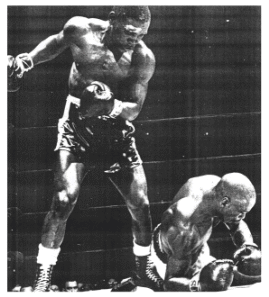
Tiger was born Richard Ihetu in 1929 in Nigeria, still then a British protectorate. He was given his ring name by a Brit who saw him fight as a youngster and proclaimed him tenacious like a tiger. In the 50's he moved to England and became a renowned fighter, and by the 60's he was one of the favorite attractions at Madison Square Garden. He was arguably the best middleweight of that middleweight-rich decade, fighting and defeating all of the era's great 160's, among them Joey Giardello, Emile Griffith and Rubin Carter, whom he destroyed in a 1965 bout at the Garden, knocking the Hurricane down three times en route to a unanimous decision (picture above left).
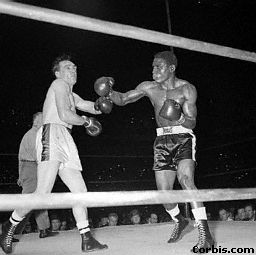 But by far Tiger's watershed fights were his three contests with legend Gene Fullmer. Tiger won the middleweight crown from Fullmer in a 1962 bloodbath in San Francisco, and then the two fought to a draw in Vegas in February of 1963. This led to their title bout at Liberty Stadium in Ibadan, Nigeria, a rumble in the jungle over a decade before Ali and Foreman ever crossed paths. It was the defining night of Tiger's career. He dominated the leather-tough Morman - Fullmer's manager threw in the towel before the start of the seventh - and the thirty-thousand plus in the stadium went mad for their native hero.
By the end of the decade, Tiger had moved up to 175 and taken the light heavyweight belt away from Cus D'Amato protege, Jose Torres. Tiger decisioned the Puerto Rican twice before losing the belt to Bob Foster. He won the 1968 Ring Magazine Fight of the Year by eking out a decision over Frank DePaula in a bout that saw both fighters on the canvas multiple times. His last fight was a loss by unanimous decision to his old rival Emile Griffith in 1970.
 By 1971, Tiger, out of boxing and down on his luck, had taken work as a security guard at the Metropolitan Museum in Manhattan. It was while on duty there that he felt a sharp pain in his back. Soon after he was diagnosed with liver cancer. Having involved himself with the Biafran cause in the late 60's, Tiger was at that point banned from his native country, but the ban was immediately lifted with news of his illness. None other than Larry Merchant, then a columnist with the New York Post, bore witness to a formal guarantee of safe passage issued by a Nigerian consulate official in Manhattan. Tiger returned to Nigeria, where he died 35 years ago today.
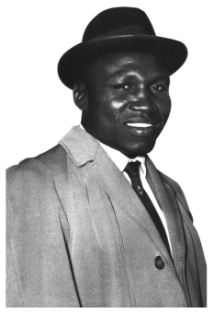 Beyond his feats in the ring and his trials as a political dissident, Tiger was also striking in his personal style. Here's a passage from a great piece on East Side Boxing that I think paints the picture nicely: "A stocky, sinewy African adorned with tribal markings on both chest and back, yet a softy-spoken British accented gentleman partial to homborg hats and Anthony Eden coats. Bemused and occasionally irritated by asides about 'headhunters' and the cannibalism supposedly practiced on his home continent, a favourite response was to quip that we "quit that years ago when the Governor-General made us sick." In time American sportswriters would go past their shallow prejudices and admire him for his personal qualities, not least of which was the quiet dignity he projected. "
0 Comments:
Post a Comment
<< Home