Classical Mythology
NO MAS BOOK REVIEW
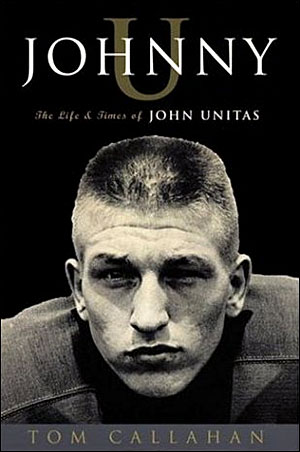
Johnny U: The Life & Times of John Unitas
Tom Callahan
Three Rivers Press, 292 p.
Tom Callahan is one of a dying breed of sportswriters, and here he tackles a dead breed of football player with a level of personal identification and idolatry that makes no bones about where he stands on the question - he loves the Baltimore Colts of the glory years, sees them as nothing short of the embodiment of a value-system and manly stiff-upper-lippitude now sadly passed in the annals of man, certainly of American man. The paperback edition of the book that has just been released comes with a blurb from Dan Shaughnessy prominenty displayed on the front cover - "Johnny U might be the best football book of all time." As John Cleese might put it, "ah... high praise indeed." For myself I'd take They Call Me Assassin in an Oakland minute, but I see Shaughnessy's point. At every opportunity, Callahan prints the myth, and thus raises an already mythological era of the NFL to truly classical porportions on the page. In one passage, he describes Unitas and Berry working on their timing patterns together being like Hector and Paris planning another invasion. He's not kidding in the least.
 One thing you'll notice very quickly with this book is that it's about Johnny Unitas in nearly the same way that Kanye's "Barry Bonds" is about Barry Bonds (for more on that breaking story, click here). Yes, yes, that's an exaggeration, but mark my words - those of you who are fascinated with seeing beneath Unitas's crewcut should not bother with this book for one minute. What you will learn of him is what you already knew - he was a man of few words, he was uncommonly cool under pressure, he commanded great respect, etc. Those of you, however (and I count among this group just about every true football fan in existence), who want to read one hilarious and insightful story after another from the titans of the glory years, clearly recounted over endless rounds of drinks at some Baltimore dive probably featured in the second season of The Wire... well, dive right in. Sample this one from ole Dunny himself on going back to New York for the '58 championship, and bear in mind there's a million more where this came from:
 Incidentally, when Weeb put us up at the Concourse Plaza in the Bronx, he didn't know that the Concourse was one my old haunts. As a teenager, I used to swipe beer from them whenever the American Legion put on a mixer. After we checking into the hotel, Don Joyce and I took a walk to Yankee Stadium. Everybody was out and about, riding their bikes and pushing their baby carriages. It was a sunny day, not too cold - a typical, beautiful, New York Saturday. "Hey Donovan," somebody on the street yelled, "the Giants are going to kick your fat ass!" I looked at Joyce and said, "These are my people."
This is a book that briefly skims over the early development of Unitas, gets him through college in about a second (he's at his infamous failed tryout for the Steelers by page 42), and then becomes a long, detailed love letter to the Baltimore Colts of the 1950's. The paperback has 276 pages of text - at page 210 you're still in 1960, and the next page jumps to 1968. You learn as much about Art Donovan and Raymond Berry as you do Johnny U, and honestly I think if I went back and counted words, I would find that as many were dedicated to Gino Marchetti as there were to the fabled quarterback. In fact, Johnny U does much more for Marchetti than it does for Unitas. Going in, Unitas sits so high on football's Parnassus that there's not really much that another breathless encomium could do for him. But Marchetti comes out of this thing seeming like the uncrowned king of the great gridiron decade. The tart refrain - "He would have cried... if he wasn't Gino Marchetti"... there simply is no higher praise in Callahan's world, and he applies it liberally.
In the end, I was a little torn about the whole enterprise. On one hand I was deeply engaged and caught up in the spirit of the endeavor, but on the other I wondered if I hadn't been swindled. In many ways this reads like a drunken oral biography, and as we all know, it's pretty easy to have a rollicking good time when you're half in the bag. The censor gets dulled. Callahan doesn't shy away from the possible inaccuracies in his tall tales, often providing different versions as told to him by different sources with the caveat that no one really knows the truth. And hey, truth be damned - who among us doesn't want to sit and shoot the shit with the great ones and hear all their war-stories, hear about the game that changed it all, the '58 championship, from the guys who were actually on the field when Unitas led that epoch-defining overtime charge? It's a damn good time, and trust me, I had a blast reading Johnny U. But I couldn't help feeling that it was something of a copout, and that it did Unitas a mild disservice. No matter how great the sources may be and no matter how essential the subject, too many war-stories strung together start to ring hollow, start to sound like a bunch of macho dudes talking about that one night they got really drunk and how crazy it was. I confess I want more. There are glimpses here and there in this book of a man whose inner workings and motivations deserve a much keener insight than the proverbial pint-glass raised in tribute. For that, I guess I'll have to wait for a biography of Johnny Unitas.


0 Comments:
Post a Comment
<< Home